




Why Jeff Bezos, Sam Altman and the World’s Leading Technology Investors Are Betting Billions on Longevity



The next great economic revolution may not be artificial intelligence. It may be the ability to live longer—and live better.
Over the past three decades, the global economy has been transformed by three major technological revolutions: the internet, the smartphone and artificial intelligence. Yet while the world remains focused on generative AI, another transformation is attracting billions of dollars from some of the most powerful entrepreneurs and investors on the planet. That transformation is longevity: the scientific and economic effort to extend healthy lifespan, delay age-related disease and allow millions of people to remain active, productive and independent for far longer. For many of the world’s leading technology investors, longevity is no longer a distant scientific ambition. It is becoming one of the largest investment opportunities of the twenty-first century.
Jeff Bezos and the rise of Altos Labs
Jeff Bezos is among the most prominent investors associated with the new longevity sector. He has been linked to Altos Labs, a biotechnology company created to investigate cellular rejuvenation, biological ageing and the possibility of restoring function to damaged or ageing cells. The company launched with approximately $3 billion in committed funding, making it one of the most heavily financed biotechnology start-ups ever created.
Altos Labs is not attempting to manufacture a conventional anti-ageing product or a superficial treatment designed to make people look younger. Its scientific ambition is far deeper: to understand why cells lose their function over time and whether biological mechanisms can be used to restore cellular health. Its work is closely associated with cellular reprogramming, a field that explores whether mature cells can be partially reset to a younger biological state without losing their identity or becoming dangerous.
To pursue that goal, the company has recruited internationally recognised scientists in molecular biology, genetics, regenerative medicine and cellular research. The scale of its funding demonstrates how dramatically the perception of longevity science has changed. What was once considered speculative research is now attracting the type of capital normally reserved for the world’s most ambitious technology companies.
Sam Altman’s major investment in Retro Biosciences
Sam Altman has also made a substantial personal commitment to longevity. The technology entrepreneur and OpenAI leader invested heavily in Retro Biosciences, a company whose stated ambition is to extend healthy human lifespan by at least a decade.
Retro Biosciences began with around $180 million in initial funding, much of it reportedly provided by Altman. Its research focuses on several areas, including cellular reprogramming, autophagy and plasma-inspired therapies. Autophagy is the natural process through which cells remove damaged components and recycle internal material, while plasma research examines whether factors circulating in the blood may influence ageing and tissue regeneration.
Altman’s interest in the sector reflects a broader belief shared by many technology investors: artificial intelligence could dramatically accelerate biological research. AI systems can examine enormous volumes of scientific data, identify patterns across complex biological systems, assist in protein modelling, optimise drug discovery and help researchers design experiments more efficiently. The combination of advanced AI and biotechnology could compress years of scientific work into much shorter development cycles.
Alphabet, Calico and a decade-long commitment to ageing research
The longevity race extends far beyond Bezos and Altman. Alphabet, Google’s parent company, launched Calico Life Sciences in 2013 to study the biology of ageing and age-related disease. Calico has pursued long-term research into the mechanisms that influence lifespan, cellular decline and disease progression.
Its creation was an early indication that some of the world’s largest technology companies saw ageing not simply as an unavoidable natural process, but as a complex biological system that could potentially be analysed and influenced. Calico’s work, together with partnerships in the pharmaceutical industry, helped move longevity research closer to the centre of mainstream biotechnology.
The importance of Alphabet’s involvement lies not only in its financial resources, but in the mindset it brought to the field. Technology companies are accustomed to tackling problems at extraordinary scale, investing for long periods and combining computing, data and scientific expertise. Longevity research requires precisely that kind of patience and ambition.
Why technology investors see longevity as the next major market
The scientific opportunity is enormous, but the economic logic is equally powerful. The world is ageing rapidly. According to United Nations projections, the global population aged 65 and over is expected to rise sharply over the coming decades, creating unprecedented demand for healthcare, diagnostics, financial services, housing, mobility, nutrition, insurance, technology and solutions that support longer independent lives.
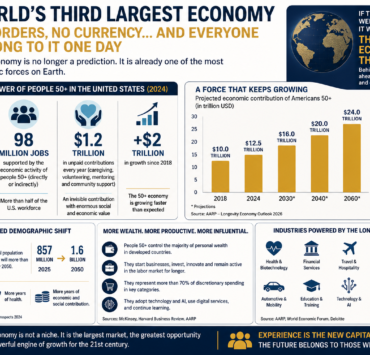
At the same time, people over 50 already represent one of the most powerful consumer groups in the global economy. In the United States alone, the economic activity associated with the 50-plus population amounts to trillions of dollars annually and supports tens of millions of jobs. This generation controls a large share of household wealth, financial assets and discretionary spending in developed markets.
For investors, this means that longevity is not one industry. It is an economic platform that touches almost every industry. A breakthrough that extends healthy lifespan would affect healthcare expenditure, retirement planning, insurance models, property markets, workforce participation, consumer behaviour, education, tourism and long-term investment. The commercial consequences could be greater than those created by many previous technological revolutions.
From treating disease to targeting the biology of ageing
Traditional medicine is largely organised around treating individual diseases after they appear. Cancer, cardiovascular disease, neurodegeneration, diabetes and frailty are generally approached as separate medical problems. Longevity science proposes a different framework: many chronic diseases may share underlying biological mechanisms connected to ageing itself.
Researchers are studying processes such as cellular senescence, mitochondrial decline, DNA damage, chronic inflammation, epigenetic changes and loss of protein stability. If scientists can intervene in those mechanisms, they may be able to delay several age-related diseases at once rather than treating each condition separately.
This does not mean that ageing has already been solved or that any company has discovered a proven way to reverse human ageing. Most of the most ambitious research remains experimental, and many scientific questions are unresolved. Yet the possibility of extending healthy life by even a few years would have extraordinary medical and economic consequences.
A treatment that delayed the onset of several chronic diseases could reduce pressure on healthcare systems, improve quality of life, extend careers and allow people to remain independent for longer. That potential explains why investors are willing to commit large amounts of capital despite the uncertainty and long development timelines.
Artificial intelligence could transform longevity research
Artificial intelligence is becoming one of the most important tools in biotechnology. It can analyse genetic information, medical images, clinical records, biological pathways and chemical compounds at a scale that would be impossible for human researchers alone.
In drug discovery, AI can help identify promising molecules, predict interactions and prioritise candidates for laboratory testing. In diagnostics, it can detect early signs of disease and combine multiple biomarkers to estimate biological risk. In personalised medicine, AI may help design interventions based on an individual’s genetics, lifestyle, medical history and biological age.
The convergence of AI and longevity is therefore one of the central reasons technology entrepreneurs are entering the sector. The same investors who helped build the digital economy now believe computing power can be applied to the complexity of human biology.
This convergence could create a new generation of companies operating at the intersection of software, biotechnology, medicine and data. Their products may include AI-designed drugs, continuous health monitoring, biological-age tests, personalised preventive programmes, robotic care systems, regenerative therapies and platforms capable of predicting disease years before symptoms appear.
The longevity economy extends far beyond biotechnology
Although biotechnology receives much of the attention, the longevity economy is far broader. It includes preventive healthcare, digital medicine, wearable devices, precision nutrition, cognitive health, assisted mobility, smart housing, financial planning, education, travel, wellness, insurance, robotics and luxury services designed for longer lives.
The financial-services industry will need to adapt to clients who may live for thirty or forty years after traditional retirement age. Employers will need to rethink careers, reskilling and multigenerational workforces. Real-estate companies will need to create homes and communities that support independence without becoming clinical or institutional. Tourism companies will serve millions of experienced travellers with time, wealth and high expectations. Technology companies will design products for users who expect to remain active, connected and professionally involved throughout longer lives.
Every additional healthy year creates further demand across these sectors. It also changes the value of education, savings, professional experience and personal relationships. A society in which people routinely live longer and remain healthy for more years will behave very differently from the societies for which most current institutions were designed.
The world’s largest investors are following the demographic reality
The interest of Bezos, Altman, Alphabet and other technology investors is not driven solely by personal fascination with living longer. It reflects a clear understanding of demographic change. The global population is ageing, wealth is increasingly concentrated among older consumers, and the demand for healthier and more independent lives is rising.
Investors are looking for companies that can solve expensive and universal problems. Ageing is both. Every person experiences it, every healthcare system is affected by it and every economy must adapt to it. Even modest improvements in healthy lifespan could create vast new markets.
The companies that succeed may not produce a single miracle cure. More likely, the sector will advance through a combination of therapies, diagnostics, preventive tools and lifestyle interventions. The commercial winners may include pharmaceutical groups, AI companies, healthcare platforms, data businesses, device manufacturers and service providers that help people manage longer lives.
Experience will become even more valuable
Longer healthy lives will not only transform medicine. They will change the meaning of professional life. People may work for more years, begin new careers later, return to education repeatedly and create companies at ages that previous generations associated with retirement.
This has major implications for talent. In a world dominated by artificial intelligence, experience becomes more valuable, not less. AI can automate routine work and expand productivity, but it cannot fully replicate judgement, trust, resilience, leadership or knowledge accumulated over decades.
The combination of longevity and AI could therefore create a new model of human productivity: people living longer, remaining economically active and using technology to amplify their expertise. This is one of the central ideas behind the longevity economy. Longer lives are not merely an additional cost for society. Properly supported, they can become a source of innovation, entrepreneurship, consumption and leadership.
The greatest business opportunity of the century
At FIFTIERS, we have consistently argued that the longevity economy will become one of the central engines of global growth. The investments made by Jeff Bezos, Sam Altman, Alphabet and other technology leaders reinforce that view.
They are not committing billions because ageing is a fashionable subject. They are doing so because they recognise the scale of the market, the accelerating power of artificial intelligence and the possibility that biotechnology may redefine the limits of healthy human life.
Artificial intelligence will transform how we work. Longevity will transform how long we can contribute. Together, they may redefine the global economy for generations.
Discover more from FIFTIERS
Subscribe to get the latest posts sent to your email.
What's Your Reaction?