





THE WORLD’S THIRD LARGEST ECONOMY HAS NO BORDERS, NO CURRENCY… AND EVERYONE WILL BELONG TO IT ONE DAY


The Longevity Economy has become the defining economic force of the twenty-first century.
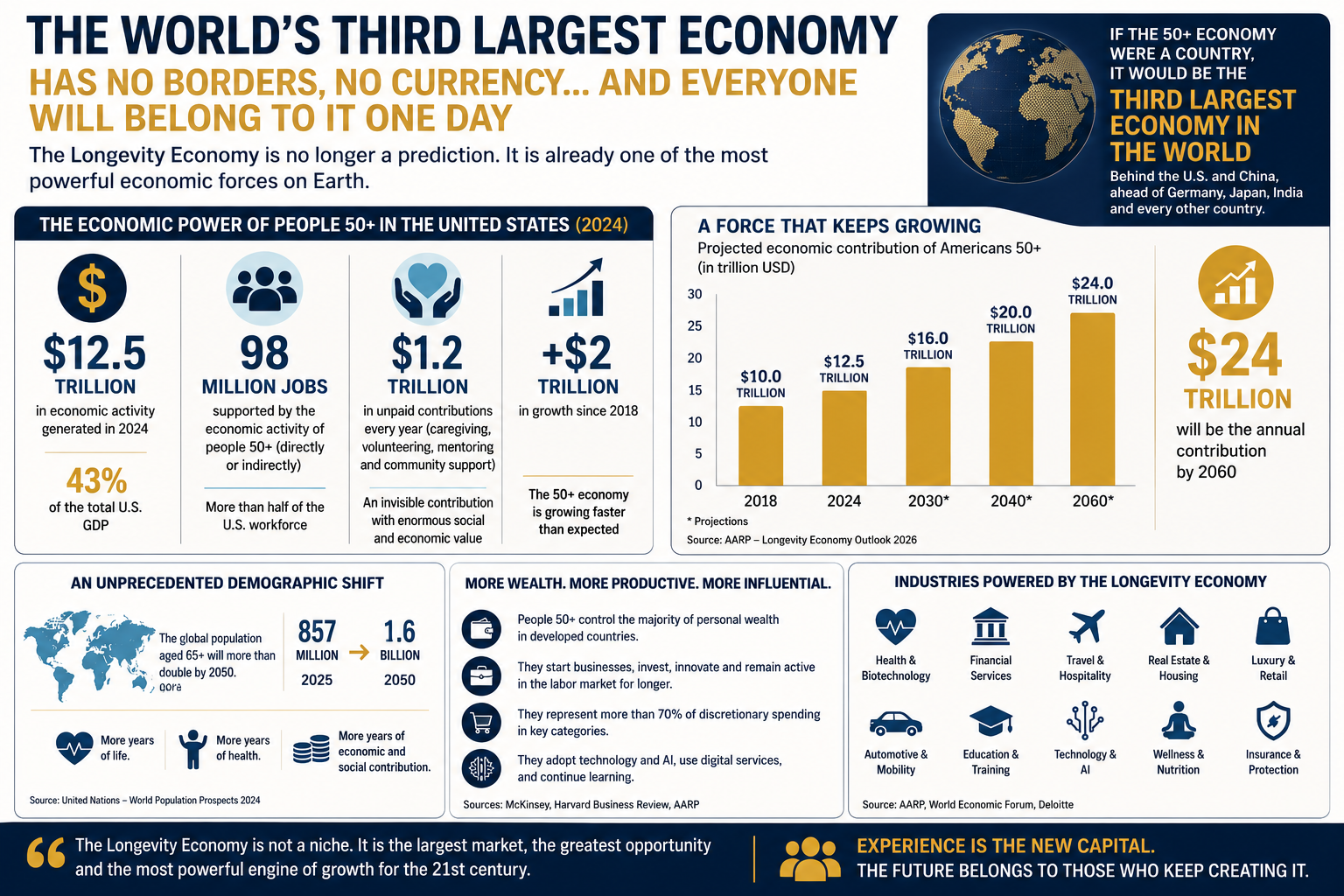
For decades, governments, corporations and investors have concentrated their attention on younger generations, convinced that economic growth depended primarily on the purchasing habits of Millennials and Generation Z. Entire industries were redesigned around this assumption, from technology and fashion to media, mobility and financial services. Yet while the world’s attention remained focused elsewhere, another economic force was expanding at an unprecedented pace. Today, that force has become impossible to ignore. According to the Longevity Economy Outlook 2026, published by AARP, Americans aged 50 and over generated $12.5 trillion in economic activity during 2024, representing 43% of the entire U.S. Gross Domestic Product. If this economic output belonged to a sovereign nation, it would immediately rank as the third-largest economy in the world, surpassed only by the United States and China and exceeding the economic output of Germany, Japan, India, the United Kingdom, France and every other national economy. Since 2018, the contribution of Americans over 50 has increased by more than $2 trillion, demonstrating that the Longevity Economy is expanding considerably faster than most strategic forecasts anticipated. The same report estimates that by 2060, this contribution will reach approximately $24 trillion annually, almost doubling its current size. These figures alone should fundamentally reshape how boards of directors, investors and policymakers think about future growth. (Source: AARP Longevity Economy Outlook 2026.)
Yet GDP represents only part of the story. The generation over 50 supports an estimated 98 million American jobs, equivalent to well over half of the country’s workforce when direct and indirect employment are combined. Every major sector increasingly depends on their purchasing power, investment decisions and accumulated experience. Healthcare, pharmaceuticals, financial services, insurance, hospitality, aviation, luxury goods, automotive, housing, education, professional services, technology and entertainment all derive a substantial share of their revenues from consumers who have already celebrated their fiftieth birthday. Moreover, adults over 50 contribute approximately $1.2 trillion every year in unpaid caregiving and volunteer work, providing childcare, caring for ageing relatives, supporting healthcare systems, mentoring younger generations and strengthening communities. This enormous contribution rarely appears in GDP calculations despite representing one of society’s greatest sources of economic and social value. (Source: AARP.)
The demographic forces behind this transformation are equally compelling. According to the United Nations, the global population aged 65 and over will more than double, rising from around 857 million people in 2025 to approximately 1.6 billion by 2050, while life expectancy continues to increase across most developed and emerging economies. For the first time in human history, societies are entering an era in which living well into one’s eighties and nineties will become increasingly common rather than exceptional. This is not merely a healthcare achievement; it represents one of the largest economic transformations ever experienced. Longer lives create longer careers, more years of consumption, greater accumulation of wealth, increased entrepreneurial activity and entirely new markets that barely existed a generation ago. (Source: United Nations World Population Prospects.)
The financial profile of this generation explains why businesses are rapidly changing their priorities. Across developed economies, adults over 50 control the majority of household wealth, own most financial assets, dominate retirement savings and account for a very large proportion of discretionary spending. They purchase premium products, travel more frequently, invest more capital, renovate homes, support multiple generations of their families and increasingly embrace digital technologies. Contrary to long-standing stereotypes, they are not withdrawing from economic life—they are redefining it. Research from McKinsey consistently shows that older consumers are becoming one of the fastest-growing sources of demand across sectors including luxury, wellness, healthcare, financial advice and high-value services. Companies that continue allocating disproportionate resources exclusively to younger demographics are increasingly overlooking the customers with the highest purchasing power and the strongest long-term loyalty.
Business leadership is evolving just as rapidly. Around the world, founders over 50 are creating companies at record levels, while experienced executives continue occupying key leadership positions across multinational corporations. Numerous academic studies have shown that entrepreneurs who launch businesses later in life often achieve higher survival rates and stronger long-term performance than younger founders because they combine decades of expertise, broader professional networks, greater financial discipline and deeper industry knowledge. Artificial intelligence is reinforcing this trend rather than reversing it. AI can automate repetitive processes, analyse enormous datasets and generate content within seconds, but it cannot replace judgement developed through decades of decision-making, crisis management, negotiation and strategic leadership. As technology becomes more accessible, experience becomes even more valuable.
The investment community has already recognised this shift. Billions of dollars are flowing into longevity science, preventive healthcare, biotechnology, age-related diagnostics, precision medicine, nutrition, cognitive health, mobility, robotics and healthy ageing. Major investment funds increasingly consider longevity one of the defining investment themes of the coming decades. Pharmaceutical companies are extending research into healthy lifespan, insurers are redesigning products around longer lives, luxury brands are adapting to more affluent mature consumers, real estate developers are reimagining housing for longer careers and independent living, while financial institutions are building entirely new advisory models for clients who may enjoy retirement lasting thirty years or more.
This is precisely why the expression “Longevity Economy” is no longer simply a demographic concept. It has become a strategic framework for understanding where global capital, innovation, entrepreneurship and consumption are heading. Every additional year of healthy life creates demand for products, services, education, travel, housing, technology and financial planning. Every generation reaching fifty does so with higher educational attainment, greater digital literacy, stronger purchasing power and longer life expectancy than the generation before it. The economic consequences of this evolution will continue to accelerate throughout the coming decades.
At FIFTIERS, we have consistently argued that turning fifty is not the beginning of decline but the beginning of influence. Experience has become one of the world’s most valuable economic assets. In an era increasingly shaped by artificial intelligence, automation and demographic change, wisdom, credibility, resilience and long-term vision are emerging as competitive advantages that cannot be replicated by algorithms. The latest international data leaves little room for debate. The most powerful economic force of the coming decades is already here. It has no borders. It has no government. It has no currency of its own. Yet it already generates trillions of dollars every year, supports tens of millions of jobs, controls a dominant share of global wealth and continues to grow at extraordinary speed.
The future of the global economy will not be defined by age. It will be defined by longevity. And the organisations that understand this first will lead the decades ahead.
Discover more from FIFTIERS
Subscribe to get the latest posts sent to your email.
What's Your Reaction?