




Longevity is no longer a demographic trend: it is creating a new global economic architecture

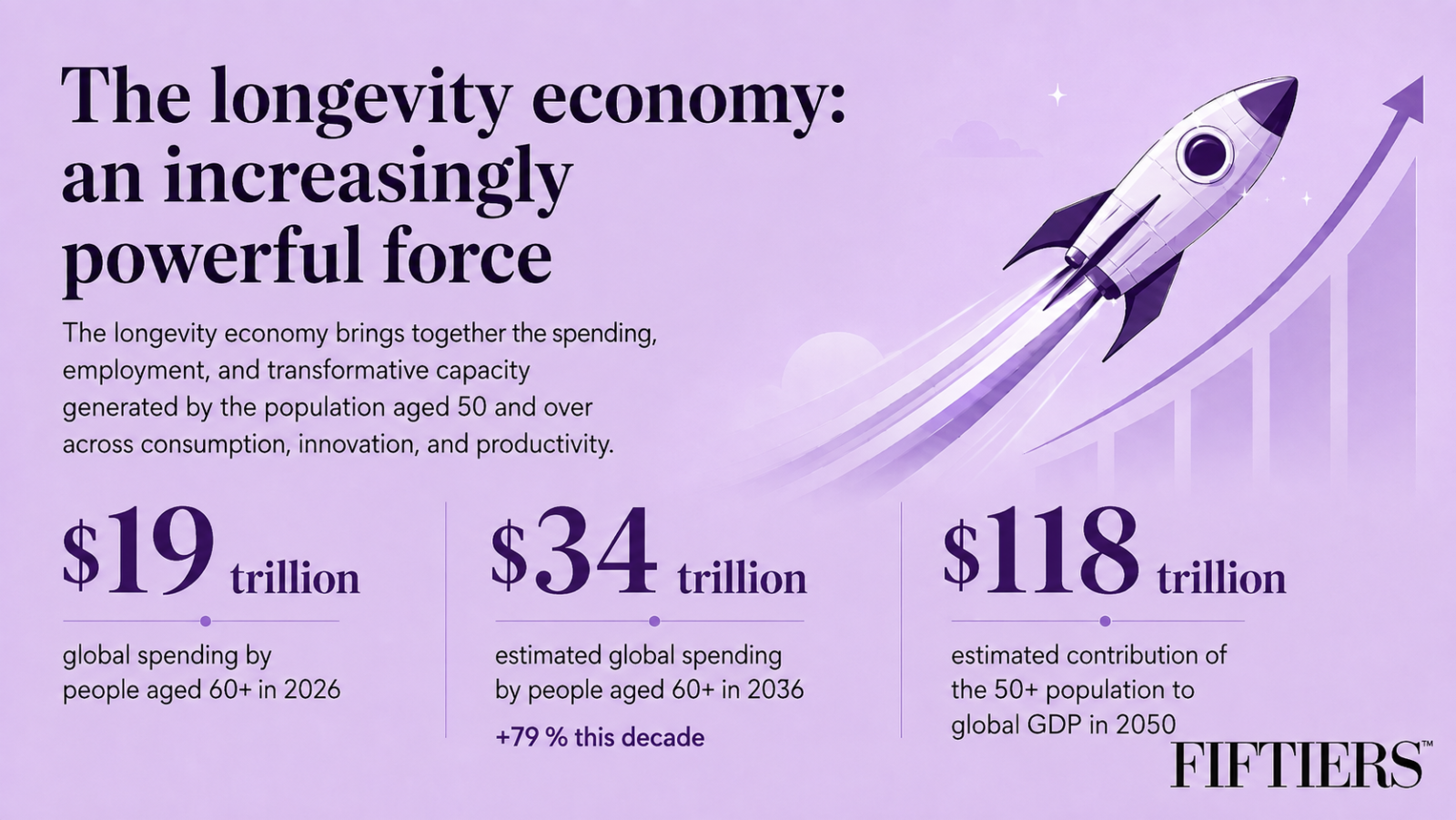

For years, population ageing was discussed primarily as a demographic phenomenon. More people were reaching advanced ages, birth rates were declining, life expectancy was increasing and governments were asking how pensions, healthcare and long-term care could be financed. That interpretation is becoming insufficient. What is happening is not simply that there are more older people; millions of human beings are adding additional decades to their lives, and those decades must be financed, inhabited, supported, enjoyed and productively used. Longevity is therefore moving beyond being a consequence of demographic change and becoming a new economic architecture capable of transforming virtually every industry. When someone can live to 90 or 100, their relationship with work, savings, housing, healthcare, consumption, education, leisure, family and wealth changes. When this happens simultaneously to millions of people, it becomes a structural economic transformation.
Many organisations still make the mistake of interpreting this phenomenon exclusively as growth in the senior market. The Longevity Economy is considerably broader. It does not begin at 65, nor is it limited to care homes, hearing aids, home assistance or adapted products. A 52-year-old beginning to invest to finance potentially another four decades of life is already participating in it. So is a 58-year-old executive who needs to update her skills to remain professionally active for another fifteen years, a couple in their sixties adapting their home so they can remain there until 85, a 45-year-old consumer investing in prevention because he wants to reach 80 with physical and cognitive capacity intact, or a company discovering that much of its institutional knowledge resides in employees over 50. Longevity begins long before old age. This is precisely where one of the greatest business shifts lies: markets will increasingly be organised not around chronological age, but around the needs created by longer lives.
Financial infrastructure will be among the first systems forced to change. Much of today’s economic model was designed around a relatively predictable sequence: education, several decades of employment, retirement around 65 and then a limited period financed through pensions and accumulated assets. A 95-year life fundamentally alters that equation. Wealth must last longer, inheritances may arrive later, demand for retirement income will increase and new mechanisms will be required to protect people who may retain substantial assets for decades while gradually losing the ability to manage them. Banks, insurers, pension funds, wealth managers and fintech companies will need to build an entire Financial Longevity industry. The question will no longer simply be how much money somebody has accumulated, but whether that wealth can finance thirty additional years while preserving independence, protection and quality of life.
Healthcare will undergo an equally profound transformation. Most existing systems are fundamentally organised around disease: diagnose a problem and treat the pathology. A longevity society will need to shift enormous resources towards prevention. If millions of people reach very advanced ages but spend their final twenty years accumulating chronic diseases and dependency, longer lifespan could place unsustainable pressure on healthcare systems. The strategic metric will therefore increasingly move from lifespan towards healthspan: how many years can people live while retaining health and functional capacity? This is creating markets around biomarkers, early diagnostics, personalised nutrition, exercise, metabolic health, cardiovascular prevention, brain health, sleep, biotechnology and continuous monitoring. The longevity consumer will not necessarily be 75. They may be 40 and prepared to invest for decades in reducing the probability of reaching 70 in poor health.
Housing represents another essential component of this emerging architecture. Ageing has traditionally been viewed through the narrow lens of residential care, yet most people want to remain independent for as long as possible. Millions of homes, neighbourhoods and cities will therefore need to change. Accessible architecture, smart homes, sensors, fall prevention, telecare, home services, intergenerational communities, Senior Living and new Longevity Living models will become part of an enormous market. Real Estate will have to ask a question that has rarely appeared in conventional development models: can this property accompany someone through thirty or forty years of physical, family and financial change? Accessibility, independence, social connection and proximity to healthcare may increasingly become elements of property value.
Work will change as well. Industrial economies created relatively linear careers and a clear boundary between employment and retirement. Longevity is eroding that boundary. If people can reach 90 in good health, it becomes increasingly difficult to assume that productive capacity automatically ends at 65. Longer careers, professional breaks, second and third careers, entrepreneurship after 50, part-time employment, mentoring and senior consulting will become more common. Education must consequently change too. Knowledge acquired at 25 cannot sustain a career lasting half a century. Lifelong learning will move from an academic concept to economic infrastructure. Artificial intelligence will accelerate this transition: experienced professionals who learn to work alongside AI could combine decades of accumulated judgement with dramatically enhanced productivity.
Consumer markets will also need a completely different approach. The traditional Silver Economy has often treated everyone over 50 as a homogeneous segment. There is no single 50+ consumer. A 53-year-old executive, a 67-year-old entrepreneur, a retired 78-year-old and a 101-year-old centenarian may belong to the same statistical category while having radically different needs, aspirations, financial resources and behaviours. Businesses will need much more sophisticated segmentation based on health, wealth, lifestyle, independence, aspirations and life stage. As increasing amounts of private wealth remain controlled by mature consumers, these generations will become increasingly influential across luxury, travel, automotive, wellness, food, education, technology, housing and financial services.
This is why longevity belongs in the boardroom. It is not exclusively an issue for governments, hospitals or companies serving older populations. Every organisation should examine how its business changes when customers, employees, shareholders and owners live twenty or thirty years longer. Insurers will have to rethink risk, banks wealth planning, property companies their assets, universities students in their sixties, travel companies affluent travellers in their seventies, technology companies lifelong usability and employers careers spanning multiple generations. Longevity is horizontal because it changes the duration of the relationship between people and almost every economic institution.
We are therefore entering a different phase. The first ageing conversation was dominated by cost: pensions, healthcare expenditure and residential-care capacity. The next conversation will increasingly include opportunity. Every additional year of life creates needs, consumption, investment and decisions. The great business transformation will be moving from asking how to support an ageing population towards asking how to design an economy for 90- and 100-year lives. That economy will require new financial, healthcare, housing, technological, educational and employment infrastructure. Companies that understand this transition early will have the opportunity to create categories that barely exist today.
Longevity is therefore not simply another industry. It is becoming a new layer of the global economy. Just as the Internet eventually transformed industries that initially believed digitalisation had little relevance to them, longer lives will reshape businesses that today do not consider themselves part of the Longevity Economy. The strategic question for every executive should no longer be whether their company serves older people. It should be much more ambitious: what must we change when our customers, employees and owners live substantially longer? The answers could reveal some of the largest markets of the coming decades.
Category: Longevity Economy & Business
Tags: longevity, Longevity Economy, Silver Economy, over 50s, healthy ageing, healthspan, Financial Longevity, Senior Living, Longevity Living, future of work, innovation, longevity business, business strategy, investment, Real Estate, lifelong learning
Prepare to lead the Longevity Economy
The FIFTIERS MBA in Longevity Business is designed for executives, entrepreneurs, investors and professionals who want to understand how longer lives are transforming markets and turn that transformation into new business opportunities.
Discover the FIFTIERS MBA in Longevity Business
See you in Madrid at the 4th FIFTIERS Congress
Discover more from FIFTIERS
Subscribe to get the latest posts sent to your email.
What's Your Reaction?