





Europe begins to treat longevity as a cross-cutting issue spanning health, housing, urban planning and the economy

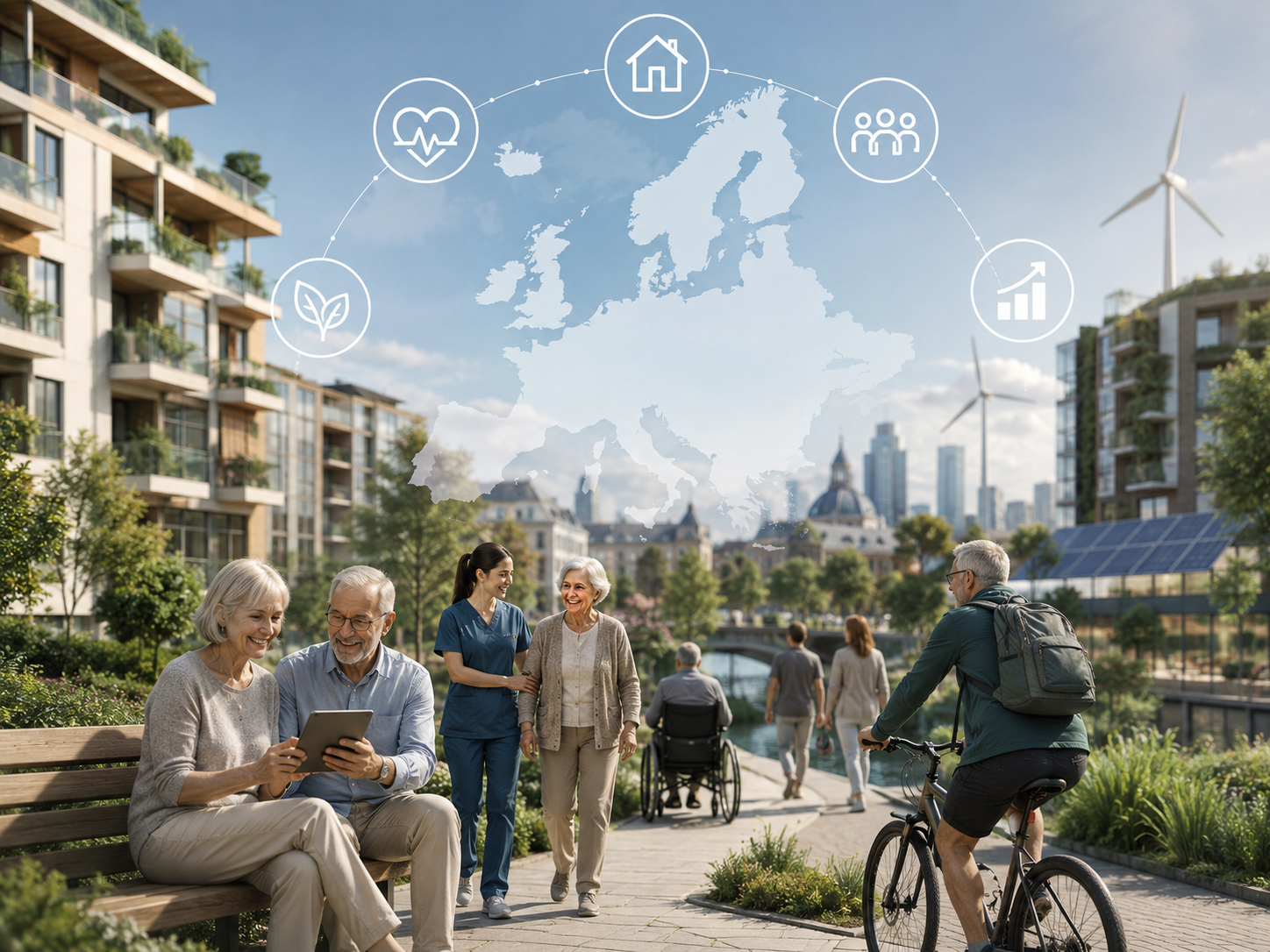

Ageing is no longer simply a healthcare challenge
Europe is beginning to make an important conceptual shift in the way it approaches longevity. For decades, population ageing was discussed primarily through the language of pensions, healthcare expenditure, dependency and long-term care. That framework is becoming insufficient. Longer lives affect not only hospitals and social services but also housing, urban planning, transport, employment, technology, financial services, consumption and the design of cities themselves. WHO/Europe’s new “Ageing is Living: Promoting a Lifetime of Health and Well-being 2026–2030” strategy reflects precisely this broader approach. It is one of the five strategic priorities of the second European Programme of Work for 2026–2030 and is designed around the idea that healthy ageing depends not only on an individual’s medical condition, but also on the physical, social and economic environments in which people spend their increasingly long lives. The demographic pressure behind this change is substantial: the population aged 60 and over in the WHO European Region is projected to increase from approximately 215 million in 2021 to 247 million by 2030 and more than 300 million by 2050, while the number of people aged 80 and over is expected to more than double by mid-century. The European Union itself has warned that around one third of its population could be over 60 by 2050. This is not simply an ageing population. It is a structural transformation of the European consumer, workforce, housing market and welfare state.
The central concept behind this new approach is functional ability. Living longer has limited value if those additional years are characterised by preventable dependency, isolation or environments that make everyday life unnecessarily difficult. Healthy ageing therefore depends partly on healthcare, but also on whether someone can leave their home safely, reach public transport, access shops and medical services, maintain social relationships, continue working if they wish and participate in community life. A poorly designed staircase can become a health problem. Inaccessible public transport can accelerate social isolation. Housing located far from essential services can increase dependency. Poor urban design can discourage walking and physical activity. Conversely, accessible housing, walkable neighbourhoods, public transport, green areas and community services can help people remain active and independent for longer. This is why longevity is beginning to move from the exclusive territory of ministries of health into the agendas of municipalities, property developers, architects, transport authorities, technology companies, employers and investors.
Housing becomes part of preventive health
Housing may be one of the areas most profoundly transformed by this new longevity perspective. Most people do not suddenly become dependent when they reach a particular birthday. Their capabilities evolve gradually, which means homes designed for a 45-year-old may become difficult to use at 75 or 85. Europe will therefore need a much broader spectrum of housing solutions: adaptable conventional homes, accessible urban apartments, intergenerational developments, senior living, assisted living, cohousing and technology-enabled homes designed for aging in place. The crucial change is to stop thinking of housing for older people exclusively as care facilities. Longevity Real Estate can begin decades before dependency. A home can incorporate step-free access, adaptable bathrooms, appropriate lighting, lifts, flexible spaces, sensors, telecare and digital connectivity without appearing institutional. WHO’s age-friendly framework already places housing alongside transport, outdoor spaces, social participation, employment, communication and community health services as interconnected components of healthy ageing.
For the real estate industry, this creates an enormous opportunity. Europe does not simply need more care homes; it needs a housing stock capable of adapting to a population that may spend thirty years or more beyond traditional retirement age. Developers that understand this early can create properties that remain suitable throughout different stages of life, while banks and insurers can develop financing products for home adaptation and care. Technology companies can provide monitoring and assistance, energy companies can improve thermal comfort and efficiency, and home-care operators can add services progressively as residents’ needs change. The home can therefore become one of the principal platforms of the Longevity Economy: a place where real estate, preventive health, technology, insurance and care converge.
Cities themselves will have to become longevity infrastructure
The same logic applies to urban planning. WHO’s work on age-friendly environments identifies accessibility, safe infrastructure, mobility, social participation and digital inclusion as important components of healthy ageing. This means the city itself can either preserve autonomy or accelerate dependency. A neighbourhood where someone can walk safely to shops, healthcare, cultural activities and public transport supports physical activity and social connection. A neighbourhood designed almost exclusively around cars, long distances and inaccessible buildings can progressively exclude people as their mobility changes. Europe therefore faces an enormous opportunity to develop Longevity Cities: urban environments designed not exclusively for older adults but for entire populations whose capabilities change throughout life.
The economic implications extend well beyond public spending. Age-friendly neighbourhoods can support local commerce because older residents remain active consumers; accessible transport increases participation; mixed-use neighbourhoods reduce isolation; and appropriate public spaces can encourage physical activity and intergenerational interaction. Municipal investment in accessibility can consequently produce health, social and economic returns simultaneously. The same principle applies to digital infrastructure. Banking, healthcare, transport, government services and commerce are becoming increasingly digital, but a longevity-ready society cannot allow technological transformation to exclude millions of older citizens. Digital inclusion therefore becomes part of urban inclusion.
Longer lives will also transform employment and the European economy
Longevity is equally important for the labour market. If people live into their 80s and 90s while birth rates remain low, Europe cannot organise economic life around a model in which education occupies the first two decades, work the next four and retirement potentially another thirty years. Longer lives will require more flexible careers, continuous reskilling, phased retirement, entrepreneurship after 50 and new opportunities for experienced professionals to remain economically active. The European approach increasingly recognises older people not simply as recipients of pensions and care but as individuals capable of contributing through employment, entrepreneurship, volunteering, mentoring, family support and consumption.
For companies, this requires a profound change in talent strategy. Organisations should begin asking what percentage of their workforce will be over 50 within five or ten years, whether their reskilling programmes include mature professionals, whether workplace design supports different physical capacities and whether age bias is causing valuable experience to leave prematurely. In a Europe facing shortages of healthcare workers, engineers, technicians and other specialised professionals, retaining experienced talent for several additional years can become an economic necessity rather than a diversity initiative. The 50+ workforce is increasingly a strategic asset.
Longevity creates markets, not only public costs
Perhaps the most important conceptual change is economic. Population ageing is usually presented as a cost: more pensions, more healthcare, more dependency and more long-term care. Those pressures are real, but they represent only one side of the equation. Hundreds of millions of Europeans over 50 will continue purchasing homes, travelling, using technology, investing, studying, exercising, consuming cultural experiences, renovating properties and purchasing financial and health services. Longer lives therefore create demand across tourism, nutrition, financial services, wellness, education, real estate, technology, mobility, luxury, insurance and entertainment.
The companies that succeed will probably be those that stop treating everyone over 50 as a homogeneous “senior market”. A 52-year-old executive, a 67-year-old entrepreneur and an 84-year-old requiring mobility support belong to completely different consumer segments. Longevity demands segmentation according to capacity, aspirations, wealth, lifestyle and life stage rather than chronological age alone. It also creates extraordinarily long customer relationships. A financial institution could accompany someone from wealth accumulation at 45 through retirement planning, decumulation, inheritance and long-term-care financing. A real estate company could move from conventional housing to active-adult living and later to serviced housing. A health platform could progress from prevention at 40 to monitoring at 60 and support at 80. Customer Lifetime Value acquires an almost literal meaning in the Longevity Economy.
Europe is moving towards a longevity economy
What Europe is beginning to recognise is that longevity cannot be solved by healthcare policy alone. A hospital cannot compensate for inaccessible housing, an excellent pension cannot eliminate social isolation, and medical technology cannot compensate for a city that prevents someone from remaining active. Healthy longevity requires coordination between health + housing + urban planning + transport + employment + technology + care + finance. This is why the European shift matters so much for executives. Population ageing should not sit exclusively inside CSR, HR or healthcare strategy. It belongs on the agenda of the board of directors.
Every organisation should be asking several fundamental questions: How will our customer base change as the population ages? How will our workforce change? Are our products accessible to people with different physical and digital capabilities? Could our business benefit from prevention, aging in place or longer working lives? Are we designing for a 100-year life or for demographic assumptions inherited from the twentieth century? Europe is effectively beginning to treat longevity as economic infrastructure. The companies that understand this before it becomes obvious may be able to build entirely new categories of products, services and assets around one of the most predictable transformations of the coming decades: millions of people living longer and expecting those additional years to be healthier, more independent and more active.
Prepare to lead the longevity economy
Longevity is transforming healthcare, real estate, urban planning, technology, financial services, employment and consumer markets simultaneously. The MBA in Longevity Business by FIFTIERS prepares executives, entrepreneurs and investors to understand this transformation, identify emerging opportunities and develop business models for an economy increasingly shaped by longer lives.
Discover more from FIFTIERS
Subscribe to get the latest posts sent to your email.
What's Your Reaction?