





Healthy aging starts at 35, not at 50


The longevity industry is moving the starting point for customer engagement much earlier
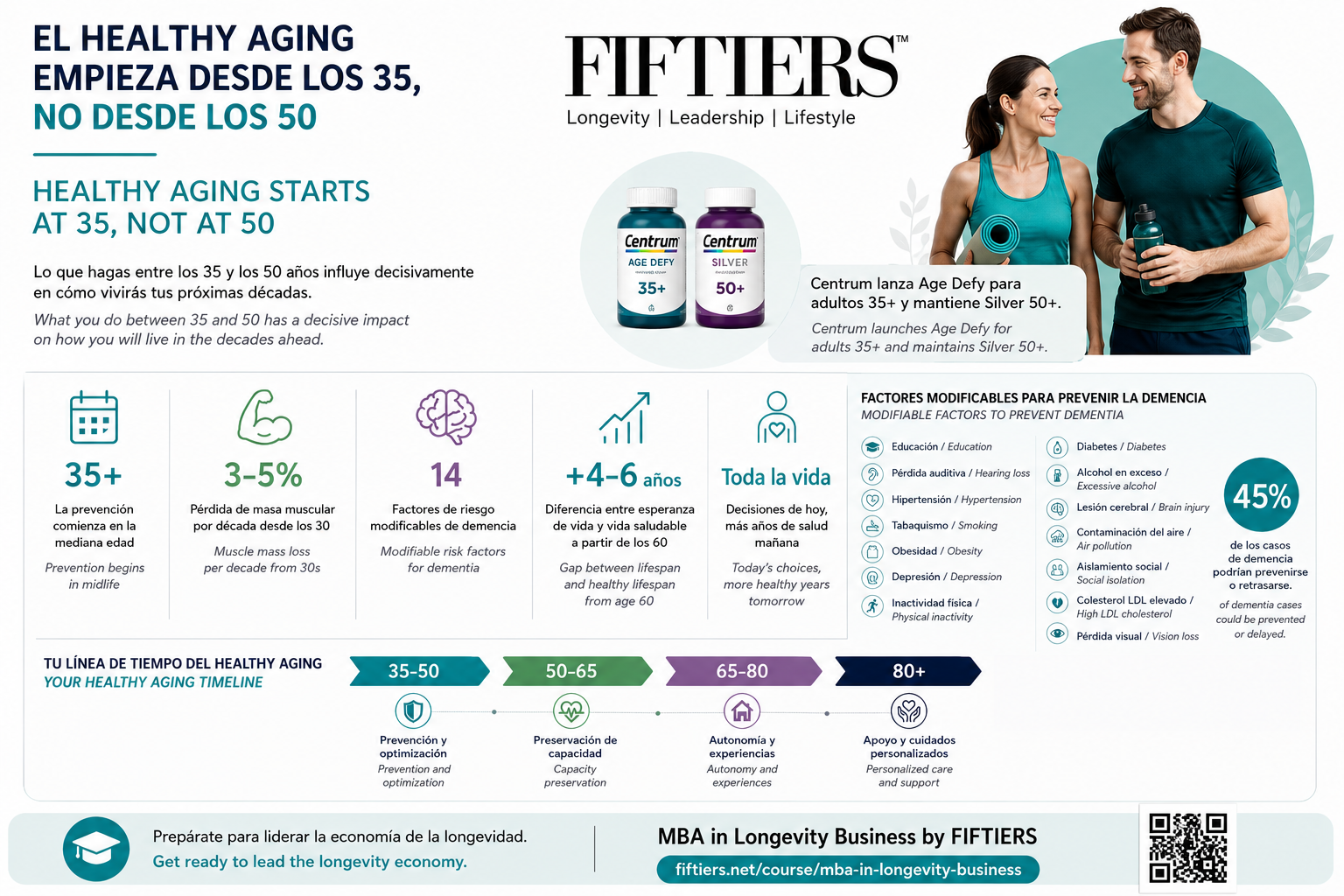
For years, much of the Longevity Economy has built its commercial strategy around consumers over 50. That boundary is beginning to look increasingly outdated. Centrum, a Haleon brand, has launched Centrum Age Defy in the United States specifically for adults aged 35 and over, while continuing to position Centrum Silver for consumers aged 50+. The move is more interesting for what it represents than for the product itself: one of the world’s best-known nutritional brands is reframing healthy aging as something that should begin in a person’s thirties, long before most consumers think of themselves as “older”. Age Defy is positioned to support 16 areas associated with healthy aging, including heart, brain, immune system, energy, metabolism, vascular health and cellular health. Its formulation includes ingredients such as resveratrol and niacin, while the broader positioning is built around a clear idea: healthy aging should be managed throughout adult life rather than addressed only when the first age-related limitations appear. There is a strong biological logic behind this strategy. Although a 35-year-old may feel far removed from aging, some physiological processes associated with declining capacity begin around this stage of life. The National Institutes of Health notes that muscle mass and strength generally peak around the age of 30 to 35, after which progressive decline begins. Estimates commonly place natural muscle loss at approximately 3% to 5% per decade after the age of 30, although individual trajectories vary considerably. The commercial implication is fundamental: at 35, the industry is no longer selling solutions for old age; it is selling future capacity.
From the anti-aging industry to 30-year prevention strategies
The conceptual shift is profound. Traditional anti-aging was largely built around appearance: wrinkles, hair, skin, weight and visible signs of age. The new healthy-aging proposition is increasingly concerned with how a person will arrive at the next decades of life. The question is no longer simply how to look younger at 45, but how decisions made between 35 and 50 could influence strength, metabolic health, cardiovascular function, cognitive capacity and independence at 65, 75 or 85. This radically expands the addressable market because companies can establish relationships with consumers decades before retirement, frailty or dependency. A brand that acquires a customer at 35 and successfully retains that relationship until 75 potentially has a forty-year commercial relationship. From a Customer Lifetime Value perspective, few demographic transformations offer a comparable opportunity. Centrum is making this transition explicit through an almost life-stage-based product architecture: Age Defy from 35 and Silver from 50. Strategically, age stops functioning exclusively as an indicator of decline and begins to organise different phases of prevention. The same model can extend far beyond nutrition. An insurer can begin cardiovascular prevention at 35; a fitness company can move from selling aesthetics to selling strength for the next forty years; a nutritional platform can track metabolism and body composition; a clinic can create a longitudinal biomarker history; and a financial institution can begin planning for a potential 90- or 100-year life. The longevity consumer no longer suddenly appears at 60. That consumer relationship can begin during the first half of adult life.
Demographics turn early intervention into a business strategy of enormous scale
The World Health Organization estimates that the global population aged 60 and over will increase from approximately 1 billion in 2020 to 1.4 billion in 2030 and 2.1 billion by 2050. By the middle of the century, people aged 60+ will represent roughly 22% of the global population. But there is an even more powerful interpretation for business leaders: many of those 2.1 billion future older consumers are already entering the Longevity Economy decades before reaching 60. Someone who will be 60 in 2050 is approximately 36 today — precisely the type of consumer that products such as Age Defy are beginning to target. This perspective changes conventional estimates of the Silver Economy. If the market is defined exclusively through consumers over 50 or 60, we are measuring the later stages of aging. If we also include people investing today in how they will age tomorrow, the potential market expands across a substantial share of the adult population. Healthy aging therefore stops being a subcategory of the senior market and begins competing with wellness, fitness, nutrition, insurance, diagnostics, beauty, tourism, technology and wealth management for consumer spending from the thirties and forties onwards.
The real product is no longer living longer, but arriving in better condition
There is also a fundamental change in the value proposition. The WHO frames healthy aging around maintaining functional ability, rather than simply avoiding every disease. This exposes one of the central contradictions of modern longevity: societies have successfully added years to life, but not all those additional years are necessarily lived in good health. WHO data show that between 2000 and 2019 the gap between life expectancy and healthy life expectancy after age 60 increased from approximately 4.1 to 4.7 years for men and from 5.3 to 6.0 years for women. Around 34% of people aged 60 and over experience substantial functional difficulties, with estimates of approximately 36.6% among women and 32% among men. This is where the real healthy-aging market lies. The opportunity is not necessarily to promise that someone will live to 110; it is to reduce the gap between lifespan and healthspan. For a 35-year-old, the relevant decision is not which senior living community they might need at 85, but how to preserve muscle, bone, metabolic health, cardiovascular function, brain health and social capacity over the next five decades. For companies, this means creating products whose ultimate return can be measured in additional years of mobility, lower metabolic risk, greater independence and delayed dependency.
Brain aging also begins long before dementia becomes visible
The same preventive logic is moving into brain health. The Lancet Commission on dementia prevention identified 14 potentially modifiable risk factors and estimated that addressing them could potentially prevent or delay approximately 45% of dementia cases. These factors include education, hearing loss, hypertension, smoking, obesity, depression, physical inactivity, diabetes, excessive alcohol consumption, traumatic brain injury, air pollution, social isolation, high LDL cholesterol and untreated vision loss. Many of these risks do not begin at 70. Hypertension, obesity, physical inactivity, elevated cholesterol and diabetes can develop during midlife, meaning that waiting until retirement to discuss brain health may be far too late from a preventive perspective. This creates a new category of brain health for consumers aged 35 to 55, combining sleep, exercise, metabolic health, hearing, nutrition, stress management, biomarkers and longitudinal cognitive assessment. Cognitive longevity may ultimately follow exactly the same trajectory now emerging in nutrition: moving from intervention after a problem appears towards building a strategy for preserving capacity decades earlier.
Muscle could become one of the most valuable assets in the Longevity Economy
Muscle loss is perhaps the clearest example of why prevention needs to start early. If muscle mass and strength generally peak around 30 to 35 and progressively decline thereafter, the optimal strategy should not consist only of trying to rebuild muscle once frailty appears at 75. It should involve creating and preserving functional reserve over several decades. This could transform the fitness industry. Gyms no longer need to sell only weight loss or aesthetics; they can sell longevity strength. Resistance training, protein intake, body-composition monitoring, preventive physiotherapy, bone density and mobility can become components of an integrated strategy beginning at 35 or 40. The same transition matters for food companies. Consumers do not necessarily want products labelled “for seniors”, a category many people would reject at 45 and perhaps even at 60. They may instead want protein to preserve muscle, nutrition designed around metabolic health, foods associated with cognitive performance, or products supporting recovery and sleep. The language moves from age to function, dramatically expanding the potential market.
The next competitive battle will be acquiring consumers before they think of themselves as old
This is perhaps the most important strategic lesson from Centrum’s move. The commercial objective is not to convince a 35-year-old that they are getting old. It is exactly the opposite: convince them that what they do today will influence how they live thirty years from now. This removes much of the stigma that has historically constrained senior marketing. Instead of selling fear, disease or decline, companies can sell strength, energy, independence, cognitive clarity and future freedom. A campaign aimed at “older people” psychologically narrows the market because many consumers do not identify with that category. A campaign centred on “your future self” can potentially reach almost any adult. Healthy aging consequently becomes an aspirational proposition. Product design changes as well: healthy-aging products do not have to look medical. They can be premium, technological, athletic, elegant or experiential. Technology companies, sports brands, wellness operators, travel businesses, insurers, banks and food companies can participate in the same economy without ever using the word “senior”.
Artificial intelligence could turn healthy aging into a personalised relationship lasting decades
The next leap will be personalisation. A 35-year-old does not require exactly the same strategy as someone aged 47 or 63, and two people of the same chronological age do not necessarily age in the same way. Genetics, physical activity, sleep, body composition, nutrition, metabolic health, stress and environment create very different trajectories. Combining wearables + laboratory testing + biomarkers + medical history + artificial intelligence could allow companies to build longitudinal models capable of identifying those differences. This creates a far more attractive economic model than selling a box of supplements. A platform could acquire a consumer at 35, establish a baseline and accompany them through periodic assessments, nutrition, exercise, sleep and prevention. The business moves from transaction to longevity subscription. Revenue becomes less dependent on selling individual units and more dependent on maintaining a trusted relationship and data history with the customer over many years. In this scenario, the most valuable asset may not be the physical product at all. It could be thirty years of longitudinal information showing how an individual is aging.
Companies should stop segmenting longevity exclusively by chronological age
The Age Defy launch also demonstrates the limitations of purely age-based segmentation. Using 35, 50 or 65 may be commercially convenient, but biologically two 50-year-olds can be in completely different situations. The next generation of longevity businesses should increasingly segment consumers according to objectives and trajectories: metabolic prevention, strength, brain health, sleep, cardiovascular health, mobility, menopause, professional performance or financial preparation for longer lives. This creates a new market architecture. Between 35 and 50, prevention and optimisation may dominate; between 50 and 65, preservation of capacity and planning for the second half of life become increasingly relevant; between 65 and 80, autonomy, experiences and prevention of frailty gain importance; and later, assistance and care needs may progressively increase. A company can potentially accompany customers through several of these stages if it designs the ecosystem correctly.
A 35-year-old customer could have a lifetime value extending forty or fifty years
From a business perspective, this may be the most powerful conclusion. Longevity companies have historically targeted older consumers because they have immediate needs and often substantial purchasing power. But acquiring customers twenty years earlier could dramatically increase Customer Lifetime Value. A person might begin with nutrition or fitness at 35, add biomarkers at 45, financial planning and advanced prevention at 50, housing products at 65, home services at 75 and specialised care at 85. This does not mean one company will necessarily provide all these services. It means longevity can become a platform for customer relationships throughout adult life. Whoever controls that relationship can potentially generate subscription, personalisation, partnership and cross-selling opportunities for decades.
From the Silver Economy to the Lifetime Economy
We may eventually need to reconsider the terminology itself. The Silver Economy was essential in making the economic power of older consumers visible. The Longevity Economy expanded the concept by recognising the economic implications of longer lives. But if brands begin acquiring customers at 35, something even broader is emerging: a Lifetime Economy, built around how decisions made throughout adulthood influence future capability. This does not reduce the importance of the 50+ consumer; it increases it. Companies can reach that stage having already built twenty years of trust, data and commercial relationships. Centrum Age Defy is therefore more than another multivitamin launch. It is a market signal. A major global brand is effectively saying that the healthy-aging consumer no longer begins at 50. The relationship begins at 35. Moving that starting point fifteen years earlier represents an extraordinary expansion of the potential market.
The next major longevity industry will be prevention before people feel old
For decades, companies waited for aging to become visible before selling solutions. The new economy will do the opposite: it will sell tools designed to help people arrive in better condition before they believe they need them. Strength before sarcopenia. Metabolic health before diabetes. Brain health before cognitive decline. Financial planning before retirement. Adaptable housing before mobility loss. The difference between these models is profound. The first monetises the problem; the second monetises decades of prevention before the problem emerges. For executives, this transformation requires a fundamental reassessment of the target market. The question should no longer be only, “What can we sell to people over 50?” The more interesting question is: “What can we start offering at 35 that helps this person arrive in better condition at 50, 70 and 90?” Companies capable of answering that question will be competing for one of the longest commercial relationships imaginable: the relationship with consumers throughout their entire adult lives.
Prepare to lead the longevity economy
Healthy aging, prevention, nutrition, artificial intelligence, brain health, fitness and metabolic health are expanding the Longevity Economy far beyond the population traditionally considered “senior”. The MBA in Longevity Business by FIFTIERS prepares executives, entrepreneurs and investors to understand these transformations, anticipate emerging markets and develop business models for increasingly long lives.
Discover more from FIFTIERS
Subscribe to get the latest posts sent to your email.
What's Your Reaction?