


Spain enters a new era of longer working lives as flexible retirement rules come into force

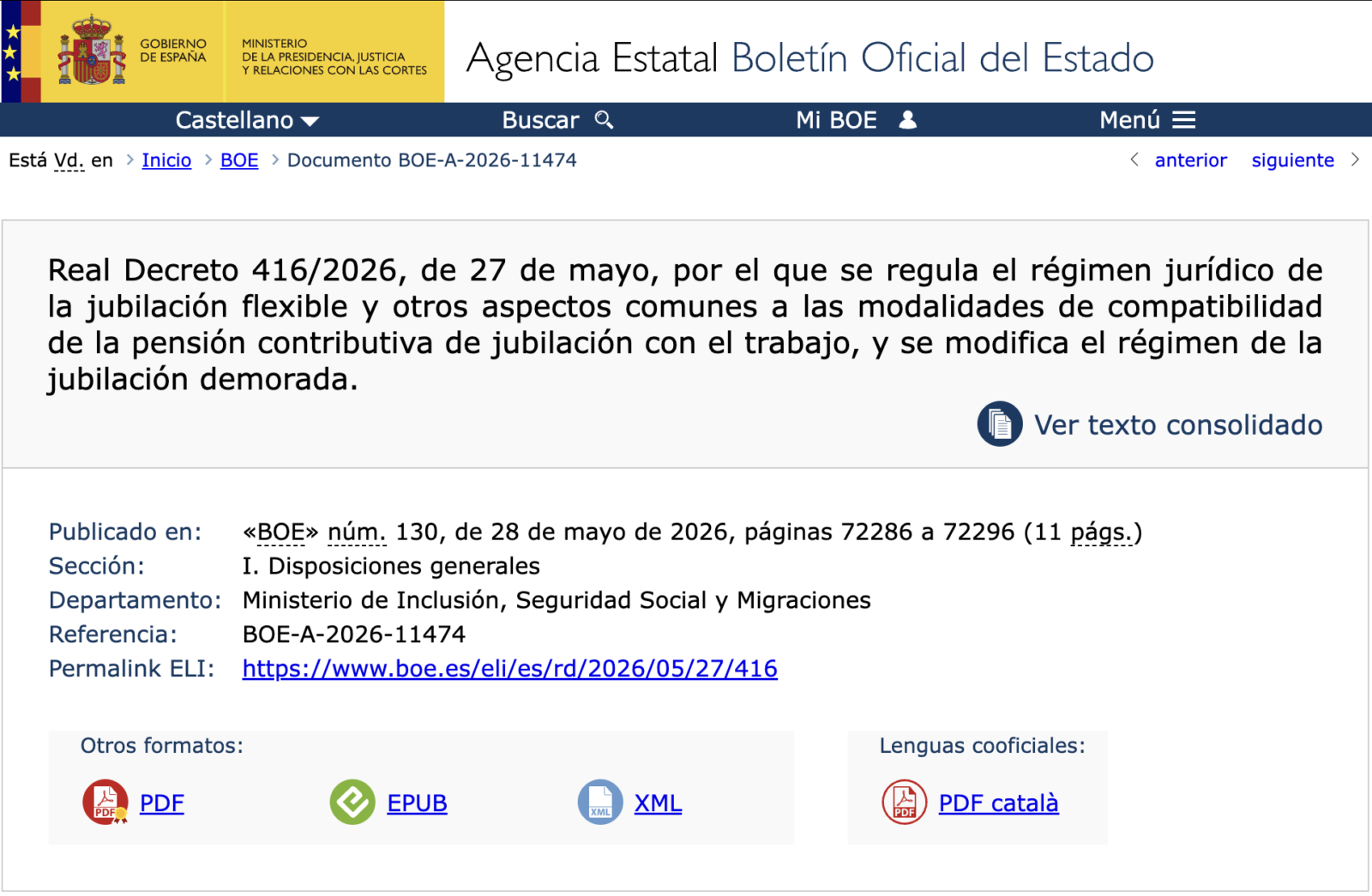

Spain takes an important step today, August 28, 2026, towards adapting its labour market to a longer-lived society. Royal Decree 416/2026, published on May 28, comes into force, reforming the flexible-retirement framework and expanding the possibilities for people who have already retired to return to work while continuing to receive part of their pension. The reform is about much more than changing a benefit. For decades, professional life was organised around a relatively clear boundary: people worked until a certain age and then largely disappeared from the labour market. Longer life expectancy, better health at mature ages and the growing need to retain experienced talent are making that model increasingly difficult to sustain in an economy where many people may live for another twenty or thirty years after reaching conventional retirement age.
Under the new framework, a retirement pension can be combined with part-time employment representing between 33% and 80% of the working hours of a comparable full-time employee. The pension payable during this period is adjusted according to the working schedule. The reform also introduces additional incentives for people returning to employment for the first time after having been retired for at least six months. Where working hours represent between 55% and 80% of a full-time schedule, the compatible pension may receive an additional 25% uplift calculated on the pension received before entering flexible retirement; where working hours are between 33% and below 55%, the additional uplift is 15%. Another major change is the inclusion of certain forms of self-employment. Retirees may combine their pension with self-employed activity when they were not registered as self-employed during the three years immediately preceding the event that gave rise to their pension. In these circumstances, 25% of the pension remains payable.
The economic importance of the reform lies not only in these percentages but in the cultural shift behind them. Spain is beginning to recognise that retirement can increasingly become a transition rather than an abrupt break. An individual may leave full-time employment, reduce responsibilities, remain professionally active for several years and finally exit the labour market when it makes sense for their circumstances. This could gradually transform both individual financial planning and corporate talent management. For an organisation, retaining a 65-, 67- or 70-year-old professional on a reduced basis can be extremely valuable when that person holds technical expertise, customer relationships, sector knowledge or institutional memory that cannot easily be replaced. Under the traditional model, that knowledge could effectively disappear from the organisation overnight.
This creates an important opportunity for Human Resources. Senior-talent management has traditionally focused heavily on when and how people leave an organisation. The Longevity Economy introduces a different question: how can companies continue benefiting from experience without requiring people to maintain exactly the same working model they followed ten years earlier? The answer can include reduced schedules, mentoring, strategic project advisory roles, commercial support, internal training, board participation, key-account management and formal knowledge-transfer programmes. Companies that design these mechanisms before experienced professionals leave may turn workforce longevity into a competitive advantage.
This is particularly relevant in sectors where accumulated experience has considerable economic value. Engineering, banking, insurance, healthcare, manufacturing, energy, consulting, professional services, construction, tourism and commercial management can lose substantial amounts of expertise when entire generations retire at similar times. In societies with lower birth rates and fewer younger workers entering some professions, replacing that experience may become increasingly difficult. Retaining mature professionals on a partial basis creates periods of generational overlap in which knowledge can be transferred more effectively. Flexible retirement could therefore become a tool for managing organisational risk.
The new rules may also support senior entrepreneurship. The possibility of undertaking certain forms of self-employment after retirement creates additional options for experienced professionals who want to convert decades of expertise into consulting, advisory work, education or small entrepreneurial ventures. This could contribute to a growing category within the Silver Economy: professionals who no longer want a conventional corporate career but do not want to withdraw completely from economic activity. A 68-year-old may still have expertise, relationships and the ability to create value for many years. Longevity requires society to stop treating those years simply as retirement and start viewing them as a potentially different stage of economic participation.
Education will also be affected. If careers become longer, skills will need to be updated for much longer. Someone remaining professionally active until 70 will need to understand tools, technologies and business models that probably did not exist when their career began. Artificial intelligence makes this challenge even more urgent. A senior professional who combines decades of sector expertise with AI tools could become extraordinarily productive, while a lack of technological updating could accelerate labour-market exclusion. Employers will need to abandon the assumption that advanced training is mainly for younger employees and build reskilling strategies for workers in their fifties, sixties and beyond.
There is also an important financial dimension. Traditional retirement planning followed a relatively simple sequence: accumulate assets while working and begin consuming those assets after leaving employment. Longer lives can make that framework insufficient. Combining pension income and professional activity for a number of years can diversify income sources, delay dependence on accumulated wealth and preserve financial capacity for longer. Banks, insurers, wealth managers and pension providers may build a new generation of Financial Longevity services around this reality, replacing planning based on a single retirement date with models covering multiple stages of work, income and expenditure across several decades.
Longer careers, however, should not simply mean working more years under exactly the same conditions. A genuine longevity economy needs jobs that can be performed sustainably for longer. That requires ergonomics, flexibility, preventive health, adapted schedules, continuous learning, new productivity metrics and reduced physical demands where appropriate. Expecting someone at 68 to work under exactly the same model they followed at 45 is not a longevity strategy. The opportunity lies precisely in redesigning work to use different capabilities at different stages of life.
For boards of directors, today’s reform should therefore trigger a conversation extending well beyond HR. How much critical company knowledge currently sits with employees over 55? What would happen if a large proportion retired over the next five years? Are formal knowledge-transfer systems in place? Could some of these professionals maintain a partial relationship with the organisation after retirement? Is the company investing in their technological development? These questions are becoming part of human-capital management in a longevity society.
Spain’s reform will not by itself solve the challenge of longer careers, and individual circumstances will still need to be assessed carefully under applicable labour, tax and Social Security rules. Nor does it mean that everyone should continue working after retirement. Its importance lies in expanding choice. Instead of organising retirement around a single exit date, different individuals can increasingly build different transitions between employment and retirement.
This may become one of the defining changes of the Longevity Economy. During the twentieth century, much of life was organised around three large stages: education, work and retirement. Ninety- and 100-year lives may make that structure too rigid. The future is likely to include lifelong education, multiple careers, career breaks, entrepreneurship, part-time work and gradual transitions into retirement. The arrival of Spain’s new flexible-retirement framework is another indication that institutions are beginning to adapt to this reality.
For businesses, the opportunity is clear: experience does not necessarily have to retire on the same day a pension begins. Learning to combine longevity, flexibility and accumulated knowledge may become one of the new competitive advantages in the labour market.
Prepare to lead businesses in a longer-lived society
The FIFTIERS MBA in Longevity Business prepares executives, entrepreneurs and investors to understand how longevity is transforming employment, Human Resources, pensions, financial services, healthcare, Real Estate and the new markets connected to 50+ generations.
Discover the FIFTIERS MBA in Longevity Business
See you in Madrid at the 4th FIFTIERS Congress
Participants of the FIFTIERS MBA in Longevity Business will meet in Madrid on November 27 at the 4th FIFTIERS Congress, where we will explore how longer lives and longer careers are transforming companies, markets and business models.
Discover the 4th FIFTIERS Congress and reserve your place
Discover more from FIFTIERS
Subscribe to get the latest posts sent to your email.
What's Your Reaction?