



Accelerated Biological Aging May Explain the Rise in Cancer Among Adults Under 50


FIFTIERS | Life Begins at 50. La vida comienza a…
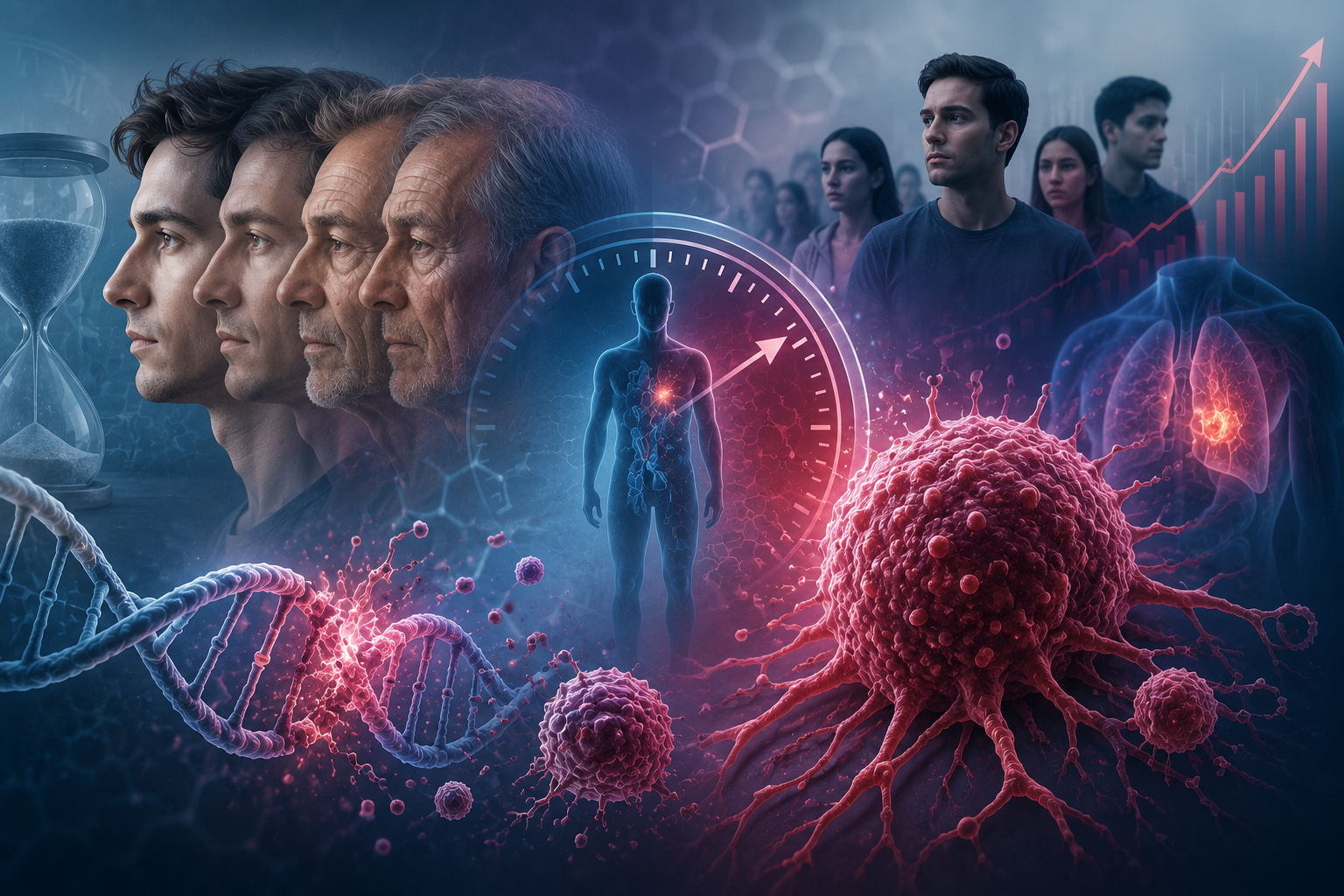
One of the most concerning trends in modern oncology is the steady increase in cancer diagnoses among adults under the age of 50. Cancers that were once considered diseases of older age—including colorectal, lung, uterine, pancreatic, and several gastrointestinal cancers—are now being diagnosed with growing frequency in younger adults across many parts of the world. Although this trend has been observed since the early 1990s, the reasons behind it have remained one of the biggest unanswered questions in cancer research. A new study published in Nature Medicine now offers a compelling explanation: younger generations may be experiencing accelerated biological aging, causing their bodies to age faster than previous generations and increasing their susceptibility to cancer at earlier ages.
The study, led by researchers at the Washington University School of Medicine and based on health data from more than 160,000 participants from the UK Biobank and several U.S. cohorts, examined the difference between chronological age—the number of years a person has lived—and biological age, which reflects the body’s actual physiological condition based on measurable biomarkers. The researchers found that individuals born in more recent decades tend to have a biological age that is older than expected for their chronological age, suggesting that the aging process itself may be occurring at a faster pace than it did in previous generations.
To measure biological aging, the scientists used several validated aging models, often referred to as biological or epigenetic clocks. Rather than simply counting birthdays, these tools estimate how rapidly tissues and organs are aging by analyzing biomarkers associated with inflammation, metabolism, immune function, organ performance, and cellular deterioration. The findings revealed that the greater the gap between biological age and chronological age, the higher the likelihood of developing certain cancers before the age of 55.
The association was particularly strong for several major solid tumors. Accelerated biological aging was linked to a higher risk of early-onset lung cancer, colorectal cancer, and uterine cancer. Interestingly, the researchers also observed that different organs appear to age at different rates. Accelerated aging of the immune system showed a particularly strong relationship with lung cancer risk, while aging-related changes in adipose tissue appeared to be more closely associated with colorectal cancer. These findings support the growing understanding that aging is not a uniform process throughout the body and that tissue-specific aging may play a central role in the development of certain diseases.
The researchers emphasize that the study does not establish a direct cause-and-effect relationship. It does not prove that accelerated biological aging causes cancer. However, it provides one of the strongest scientific hypotheses to date for explaining the global increase in early-onset cancers, an issue that has puzzled oncologists and epidemiologists for years. The findings also reinforce the idea that aging itself should be considered one of the fundamental biological processes underlying many chronic diseases, rather than merely an inevitable consequence of growing older.
One of the most important questions raised by the study is why younger generations appear to be aging more rapidly. Although the researchers did not identify a single cause, they point to a combination of environmental and lifestyle changes that have become increasingly common over recent decades. These include rising obesity rates, diets rich in ultra-processed foods, sedentary lifestyles, chronic sleep disruption, psychological stress, environmental pollution, exposure to industrial chemicals, and changes in the gut microbiome. Together, these factors may promote chronic low-grade inflammation and accelerate cellular damage long before disease becomes clinically apparent.
The study could also have major implications for cancer prevention. If future research confirms these findings, biological age could become an important new tool for identifying individuals at higher risk long before cancer develops. Rather than relying solely on chronological age, healthcare systems may eventually personalize cancer screening programs according to each person’s biological aging rate, allowing earlier surveillance, more targeted prevention strategies, and potentially earlier diagnosis.
Beyond oncology, the research provides further momentum for one of the fastest-growing areas of longevity medicine: measuring biological aging itself. In recent years, scientists have developed increasingly sophisticated epigenetic clocks and artificial intelligence–based models capable of estimating biological age through blood biomarkers, proteomic profiles, metabolic signatures, and DNA methylation patterns. While many of these technologies are still undergoing clinical validation, there is growing consensus that biological age will become one of the most valuable biomarkers in personalized medicine over the coming decade.
For the longevity economy, these findings open up an entirely new frontier. The ability to accurately measure how fast an individual is aging could transform preventive healthcare, enabling personalized wellness programs, targeted interventions to slow biological aging, and far more precise monitoring of health over time. As populations continue to age worldwide, understanding why some people age faster than others is becoming one of the defining scientific, medical, and economic challenges of the twenty-first century.
Although many questions remain unanswered, this study represents a major step forward in understanding the rise of early-onset cancers. Rather than viewing cancer solely as a disease associated with chronological age, researchers are increasingly considering the speed of biological aging as a critical determinant of when chronic diseases emerge. If this hypothesis continues to gain support, the fight against cancer may begin years before diagnosis—not by treating tumors, but by slowing the biological processes of aging itself.
Discover more from FIFTIERS
Subscribe to get the latest posts sent to your email.
What's Your Reaction?