



Is There a Biological Limit to Human Life? The New Research That Places the Frontier Near 150 Years

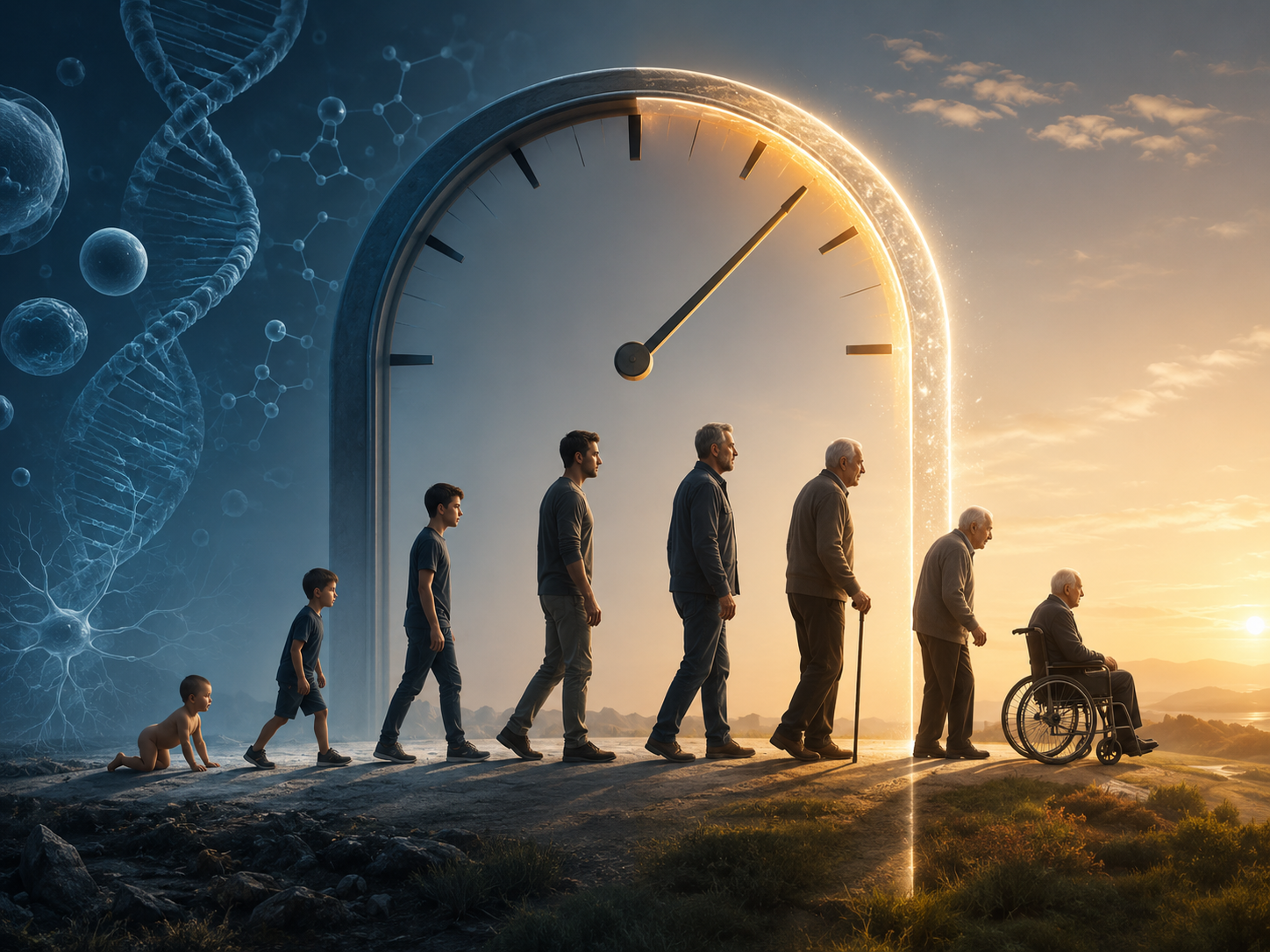

Even if science succeeded in eliminating many of the known causes of ageing, the inevitable accumulation of DNA mutations may impose a biological barrier that regenerative medicine has yet to overcome.
For centuries, humanity has asked one of the most profound questions imaginable: How long can a human being truly live? Throughout history, advances in medicine have steadily increased life expectancy, transforming what was once considered old age into the beginning of a new stage of life. Yet despite remarkable progress, one extraordinary record still stands untouched. Jeanne Calment, the French woman whose age remains the oldest ever scientifically verified, died in 1997 at 122 years and 164 days. No one has officially surpassed her. Today, however, breakthroughs in artificial intelligence, regenerative medicine, stem-cell biology, gene editing and cellular reprogramming have revived a debate that until recently belonged largely to science fiction. Could humans one day live to 150 years? Or even longer? A new study published in npj Aging, part of the Nature portfolio, suggests that the answer may be far more complicated than many researchers expected.
The study proposes that even if scientists were able to eliminate virtually every other known mechanism of ageing, the continuous accumulation of somatic DNA mutations could still impose an intrinsic biological ceiling on human longevity. According to the authors’ mathematical modelling, these mutations alone could reduce the median potential human lifespan to approximately 156 years, while simulations incorporating different organs and biological assumptions produced an estimated range between 146 and 194 years. Importantly, the researchers do not claim that humans are destined to die at 156 years, nor do they argue that nobody could ever exceed this age. Instead, they present a theoretical framework designed to isolate one single biological process—the progressive accumulation of genetic damage—and explore how much it might ultimately limit human survival.
The implications are enormous because for decades much of longevity research has focused on repairing or reversing many of the recognised hallmarks of ageing. Scientists are investigating cellular reprogramming, senolytic therapies that eliminate dysfunctional cells, stem-cell regeneration, mitochondrial restoration, epigenetic rejuvenation, advanced gene editing and artificial intelligence-assisted drug discovery. Many of these approaches have produced encouraging laboratory results. Yet the new study suggests that even if all of these technologies eventually succeed, the genome itself may continue accumulating permanent errors throughout life.
Unlike inherited genetic mutations, somatic mutations arise after conception and accumulate continuously in virtually every tissue of the body. Every time a cell divides, copies itself or repairs damaged DNA, tiny mistakes can occur. Environmental exposure, ultraviolet radiation, natural metabolic activity, oxidative stress and random molecular events all contribute to this gradual process. Most of these mutations are harmless. Some contribute to cancer. Others may slightly impair cellular function without immediately causing disease. Over many decades, however, each individual gradually becomes what scientists describe as a genetic mosaic: trillions of cells carrying subtly different genomes from one another. This silent accumulation has become one of the most intriguing areas of modern ageing research.
Evidence supporting its importance has grown considerably in recent years. A landmark study published in Nature in 2022 analysed the complete genomes of intestinal cells from sixteen mammalian species ranging from mice to giraffes and humans. Remarkably, researchers discovered a striking relationship between lifespan and mutation rate. Species that lived longer accumulated somatic mutations much more slowly than short-lived animals. Despite differences of approximately 30-fold in lifespan and nearly 40,000-fold in body mass, the total mutation burden at the end of life varied only about threefold between species. Statistical analysis showed that lifespan explained approximately 82 percent of the variation in mutation rates across those mammals. While correlation does not prove causation, the findings strongly suggest that maintaining genomic integrity may be one of evolution’s most important strategies for achieving exceptional longevity.
Building upon these observations, the new Nature Portfolio study asked a radical question. What would happen if medicine became so advanced that every recognised hallmark of ageing could effectively be neutralised? Imagine a future where chronic inflammation could be eliminated, stem cells continually replenished, damaged proteins repaired, epigenetic ageing reversed, mitochondrial dysfunction corrected and organs regenerated almost indefinitely. Under those extraordinary assumptions, the researchers mathematically removed nearly every biological ageing mechanism except one: the unavoidable accumulation of somatic mutations.
The result was striking. In their theoretical model, eliminating all recognised ageing processes except DNA mutations reduced the median lifespan to approximately 156 years. When different tissues and organs were considered separately, the estimated range extended from 146 to 194 years. Ironically, the same mathematical model predicted that if both ageing mechanisms and somatic mutations were entirely absent, the theoretical median lifespan would approach 1,759 years. The authors are careful to explain that this number should not be interpreted literally. It simply illustrates how profoundly one biological mechanism alone can constrain longevity even after many other problems have been solved.
One of the most fascinating aspects of the study concerns the remarkable differences between organs. Not every tissue ages in the same way. Organs such as the liver, skin and intestinal lining continuously replace damaged cells throughout life. If regenerative medicine became capable of supporting these renewal processes indefinitely, those tissues might theoretically maintain functionality for extraordinarily long periods. The greatest challenge instead appears in tissues composed largely of post-mitotic cells, particularly neurons in the brain and cardiomyocytes in the heart. These specialised cells divide very little—or not at all—after development. Once they accumulate genetic damage, replacing them becomes vastly more complicated because their biological function depends not only on the cells themselves but also on the complex networks they have built over decades. Replacing a neuron is not equivalent to restoring the memories, knowledge and connections it once contained. Repairing cardiac muscle involves rebuilding one of the most sophisticated electrical systems in biology. According to the model, these tissues become the primary biological bottlenecks limiting extreme longevity.
Does this mean humans will never live beyond 150 years?
The answer remains no.
The research does not demonstrate that 156 years represents a fixed biological maximum. It proposes a mathematical estimate based on current understanding of mutation accumulation and tissue failure. Human biology remains vastly more complex than any existing model. Scientists still debate how much functional damage somatic mutations actually produce outside cancer. Several researchers argue that many observed mutations may be biologically neutral, while others believe ageing results primarily from multiple interacting processes rather than any single mechanism.
Indeed, the scientific community remains divided regarding whether human lifespan possesses any absolute ceiling at all. Some demographic analyses conclude that available data do not support a fixed upper limit. Others estimate that, under present medical conditions, surviving beyond approximately 125 to 130 years is extraordinarily unlikely. Those statistical projections, however, reflect today’s biology and today’s medicine—not necessarily what future biotechnology might achieve.
Artificial intelligence is rapidly changing that landscape. AI systems are already transforming biomedical research by analysing enormous scientific datasets, identifying hidden molecular relationships, modelling protein structures, accelerating drug discovery and helping researchers design more efficient clinical trials. Technologies that once required decades of laboratory work can increasingly be explored within months. This convergence between artificial intelligence and biotechnology explains why some of the world’s leading investors—including Jeff Bezos, Sam Altman and several major technology funds—have committed billions of dollars to longevity research. They recognise that AI is not merely another digital revolution; it may become the engine that dramatically accelerates biological discovery.
Yet the study also highlights a profound challenge. Rejuvenating cells is not necessarily the same as repairing the permanent information encoded within their DNA. Cellular reprogramming may restore youthful patterns of gene activity, but it does not automatically erase every mutation accumulated over a lifetime. Future longevity medicine may therefore require technologies capable not only of regenerating tissues but also of detecting, interpreting and correcting genetic errors across trillions of cells safely and precisely—a scientific challenge of extraordinary complexity.
Ultimately, the question facing humanity may no longer be whether we can slow ageing, but which forms of biological damage will prove impossible to overcome.
At FIFTIERS, we believe this debate extends far beyond biology. If healthy lifespan were extended toward 120, 140 or even 150 years, the consequences would reshape every aspect of civilisation. Careers could span six or seven decades. Education would become lifelong by necessity. Retirement would be fundamentally redefined. Healthcare, insurance, housing, investment, entrepreneurship and family structures would all need to evolve. Experience would become one of the world’s most valuable economic assets.
The latest research does not close the debate about human longevity. It opens an entirely new one. Perhaps the greatest challenge of the twenty-first century will not be discovering how to live longer. It will be learning how to preserve the biological information that allows life itself to continue.
Discover more from FIFTIERS
Subscribe to get the latest posts sent to your email.
What's Your Reaction?