




Senior Living and Longevity Living: they are not the same, and the difference could transform the future of real estate

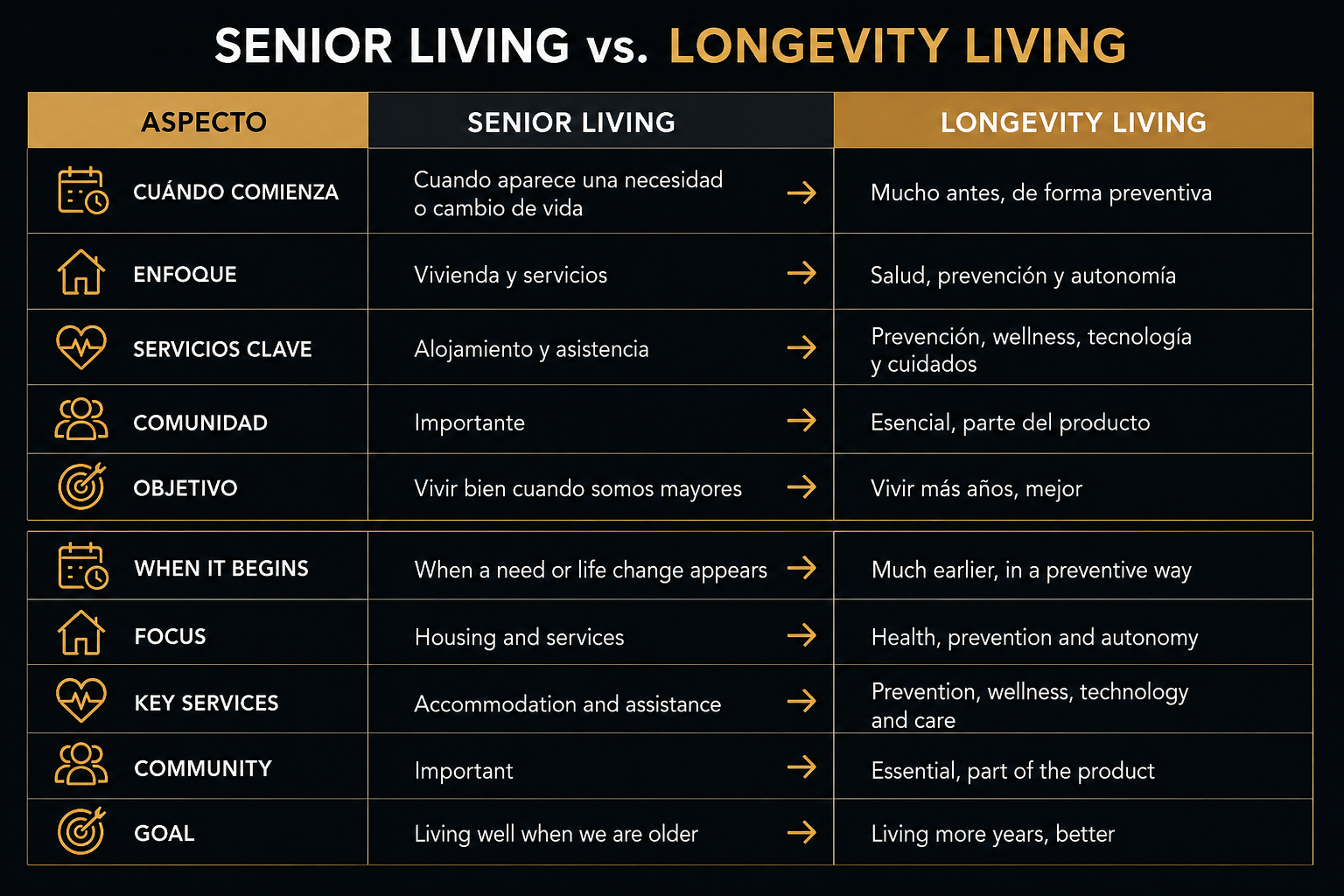

For years, the term Senior Living has been used to describe a broad range of residential solutions for older adults: active adult communities, independent living, assisted living, senior cohousing, serviced residences and models combining housing and care. But increasing life expectancy, new generations entering their 60s and 70s, and advances in prevention, wellness, artificial intelligence and AgeTech are giving rise to a more ambitious concept: Longevity Living. The difference may initially sound semantic, but it is not. Senior Living essentially asks: how do we want to live as we grow older? Longevity Living asks a broader question: how can we live longer while preserving autonomy, physical capacity, cognitive health, social relationships and quality of life? The first organises a residential solution around a stage of life. The second seeks to transform the residential environment itself into infrastructure for living better, for longer.
Senior Living: a residential category associated with a stage of life
Senior Living is an extremely broad concept and does not necessarily mean assisted care or dependency. At its most advanced, it includes communities for completely independent people who want security, services, social relationships, maintenance, activities and housing prepared for needs that may emerge with age. The category ranges from Active Adult and Independent Living to Assisted Living, Memory Care, Continuing Care Retirement Communities and different forms of senior cohousing. Its principal difference from conventional housing is that the property, architecture and services are designed specifically around the needs of an older population, influencing accessibility, safety, communal areas, activities and, depending on the model, healthcare or personal support. The extraordinary growth of Senior Living also has a demographic explanation: the oldest US baby boomers are turning 80 in 2026, and developed economies will experience rapid expansion of their 75+, 80+ and 85+ populations over the coming decades. At the same time, people are entering later life with expectations fundamentally different from previous generations. They want independence, privacy, experiences, excellent food, physical activity, technology and community. They do not necessarily want an institution that constantly reminds them of their age. This is precisely where the transition towards Longevity Living begins.
Longevity Living: from accommodating ageing to actively managing healthspan
Longevity Living should not simply be understood as a new name for Senior Living. Its proposition is different. The objective is no longer merely to provide excellent adapted housing, but to create an ecosystem capable of helping residents preserve functional capacity for as long as possible. The key concept is healthspan: the years of life spent in good health and with functional independence. A Longevity Living Community should not ask only how long a resident remains there, but how that person evolves during those years. Are they maintaining strength and mobility? Do they remain socially connected? Can they continue living independently? Are we reducing their risk of falls? Can physical or cognitive changes be identified before they become more serious problems? This turns the property into something closer to a longevity platform, where prevention becomes part of the residential proposition rather than an optional additional service.
The major difference is when the relationship with the resident begins
Senior Living often begins when a person makes a decision associated with age or changing needs. Longevity Living can begin much earlier. Imagine a completely independent 58- or 62-year-old who is still professionally active, travels, exercises and does not identify as “old”. That person is unlikely to want to move into a conventional retirement residence, but could be attracted to an exceptionally designed community offering fitness facilities, strength training, wellness, gastronomy, social spaces, security, optional preventive healthcare, technology and domestic services. That individual is not buying care. They are buying future quality of life. At 70, they might add physiotherapy or preventive programmes; at 78, selected home-support services; at 85, more assistance and potentially assisted living. The ecosystem evolves alongside the resident. This could extend the relationship between operator and customer for 20, 25 or even 30 years, radically changing Customer Lifetime Value.
From Real Estate + Care to Real Estate + Healthspan
Much of the difference can be summarised through two formulas. Senior Living = Real Estate + Hospitality + Services + Care. Longevity Living = Real Estate + Hospitality + Prevention + Wellness + Healthcare + Technology + Community + Care. This does not mean every development needs permanent physicians, hospitals or sophisticated laboratories. It means decisions about architecture, services and resident experience are made with their potential impact on autonomy and functional capacity in mind. A conventional gym can become a facility focused on strength, mobility and balance; restaurants can incorporate healthy-ageing nutrition; activities can include lifelong learning and cognitive health; gardens can encourage movement and socialisation; lighting and interior design can help reduce falls; and apartments can be designed to adapt as residents’ needs evolve. The property stops being simply the place where someone lives and starts becoming an environment designed to help preserve capability.
Invisible technology, hospitality and community
Technology also plays a different role. In traditional Senior Living, it has often focused on safety, telecare, communication and operational management. In Longevity Living, it can become preventive infrastructure. Wearables can monitor activity and sleep; non-invasive sensors can identify changes in mobility or routines; AI systems can detect patterns that warrant attention; telemedicine can connect residents with healthcare professionals; and digital tools can support nutrition, training, rehabilitation and cognitive health. The objective is not to transform the home into an intensive-care unit or subject residents to permanent surveillance. A well-designed Longevity Living Community should make much of its technology invisible, appearing when it adds value and disappearing when it does not.
Hospitality becomes equally important. Today’s consumers entering their 60s and 70s have spent decades travelling, staying in hotels, visiting restaurants, using gyms, spas and digital services. Their expectations around design, food, personalisation and service are fundamentally different from those of previous generations. Concierge, housekeeping, gastronomy, wellness, cultural programming, experiences and travel can become as important as the residence itself. Community adds another layer. Restaurants, clubs, gardens, sport, education, workspaces and intergenerational programmes can help preserve social participation and reduce isolation. Residents therefore purchase more than square metres. They purchase housing + services + experiences + relationships + security + belonging.
Senior Living responds to needs; Longevity Living tries to anticipate them
This may be the simplest way to explain the difference. Senior Living asks: what does this person need today? Longevity Living adds: what can we do today so that this person needs less assistance tomorrow? A community that identifies declining strength can intervene before a fall occurs. One that detects social isolation can encourage new relationships. Changes in functional capacity can trigger professional assessment. Exercise and nutrition programmes can help preserve physical capability. The objective is not to medicalise everyday life. It is precisely the opposite: to delay for as long as possible the point at which everyday life needs to become medicalised.
This philosophy could also transform business KPIs. Occupancy, revenue per resident, operating margins, length of stay and satisfaction remain essential, but Longevity Living can add a second generation of metrics: mobility and strength, falls avoided, hospitalisations prevented, social participation, preventive-programme engagement and time before residents require higher levels of care. If a residential model can delay dependency, it can create value simultaneously for residents, operators, families, insurers and healthcare systems.
Not every Senior Living development is Longevity Living
One mistake is likely to become common: simply changing the wording on the building. A conventional senior residence with a gym, a mobile app and a few wellness services does not automatically become Longevity Living. The concept requires an integrated philosophy connecting adaptive design, prevention, functional health, physical activity, nutrition, cognitive health, community, technology, hospitality and the ability to evolve alongside the resident. The change must exist in the operating model, not merely in the marketing. Senior Living will also remain essential. Assisted Living and Memory Care address real needs that will not disappear because a new concept emerges. Longevity Living does not replace Senior Living. It extends the market into earlier stages of life and adds a new ambition: preserving capability before managing dependency.
The future may belong to communities people want to join before they need them
For decades, the residential sector for older adults has faced a fundamental commercial problem: many people postpone moving until a health or family need forces the decision. Longevity Living can reverse that logic completely. The goal is to create communities so attractive that people want to live there before they need to. That changes everything. Consumers arrive by choice rather than necessity. Relationships begin earlier. Length of stay can increase. New services become possible. Operators have years to understand residents, and prevention can begin long before frailty emerges.
This is the fundamental distinction between the two concepts. Senior Living seeks to provide a good life as we grow older. Longevity Living seeks to create the environment that helps us age better. Senior Living will continue to expand because it responds to an undeniable demographic need. Longevity Living can expand the market even further because it begins earlier, incorporates prevention and brings real estate, hospitality, technology, wellness and health into a single ecosystem. That evolution could make longevity-focused real estate one of the defining industries of the coming decades.
Prepare to lead the longevity economy
Senior Living, Longevity Living, Longevity Real Estate, AgeTech, hospitality, prevention and wellness are converging to create a new generation of residential models. The MBA in Longevity Business by FIFTIERS prepares executives, entrepreneurs and investors to understand this transformation and identify the business opportunities emerging around increasingly long lives.
Discover more from FIFTIERS
Subscribe to get the latest posts sent to your email.
What's Your Reaction?