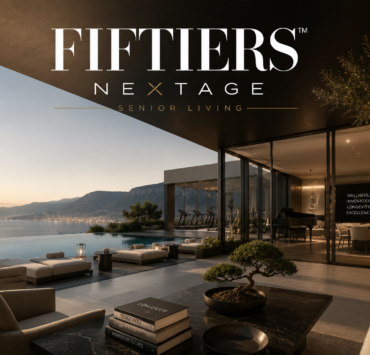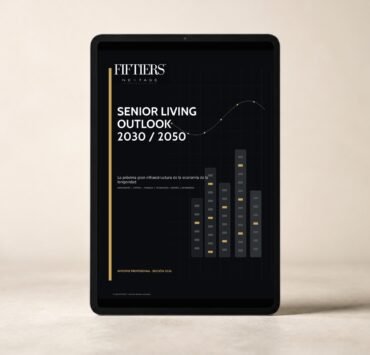



FIFTIERS™ and NEXTAGE™ Launch the Senior Living Real Estate Executive Program™, a Pioneering Executive Program for the New Longevity Real Estate Economy

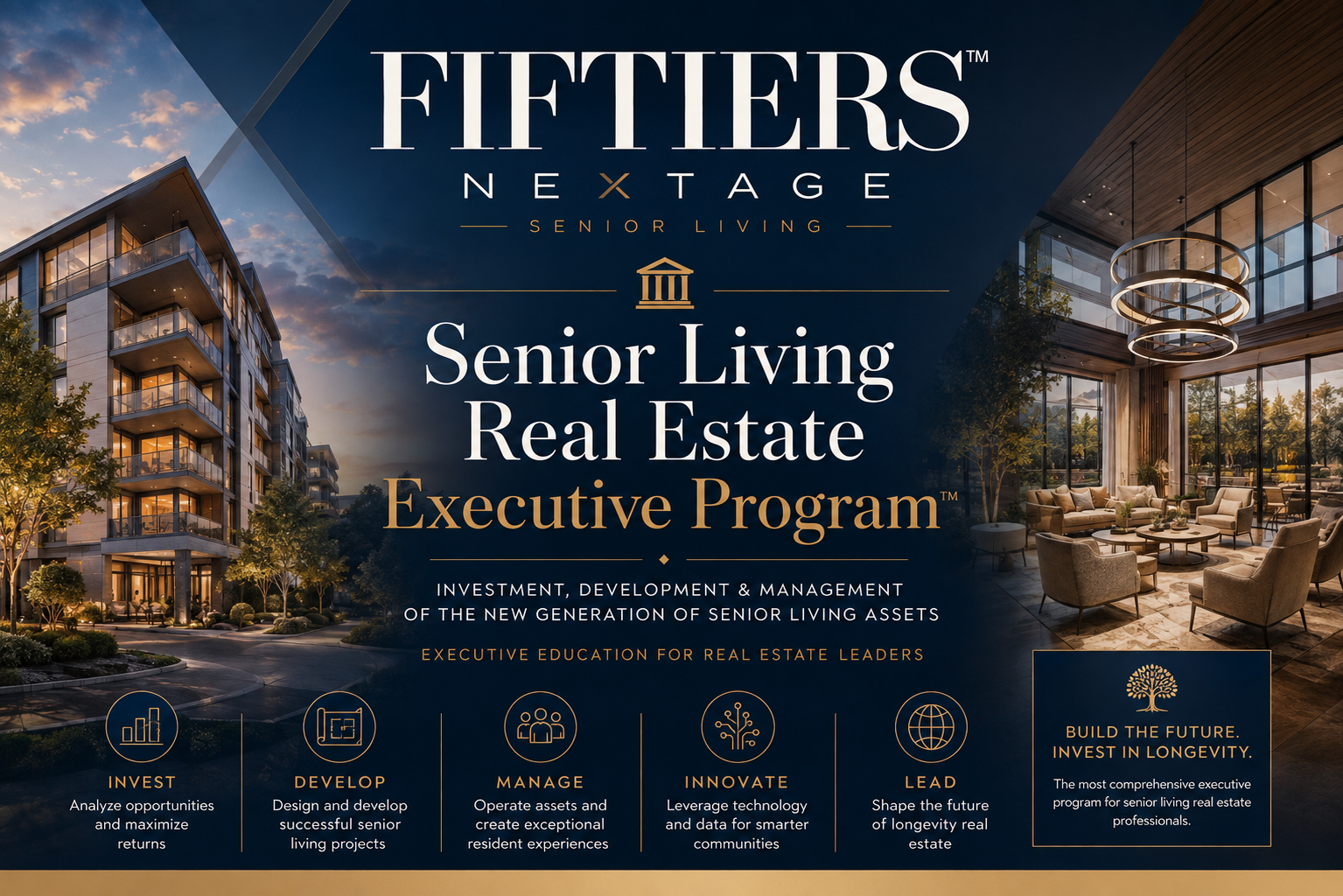

A pioneering international program designed to prepare investors, developers, asset managers, architects, operators and executives to understand, finance, develop and manage one of the fastest-emerging real estate opportunities created by global longevity
FIFTIERS™ and NEXTAGE™ announce the launch of the Senior Living Real Estate Executive Program™, a pioneering executive education initiative focused specifically on the investment, development, financing, design, operation and management of Senior Living real estate. The program is being launched at a moment when three powerful structural forces are converging: unprecedented global population ageing, longer lives and a shortage of residential solutions capable of responding to the expectations of a new generation of older consumers. Senior Living is consequently moving beyond its traditional association with care facilities and emerging as a sophisticated real estate category at the intersection of housing, investment, hospitality, wellness, healthcare, technology and community.
The demographic numbers alone illustrate the scale of the transformation. According to the World Health Organization, by 2030 one in every six people worldwide will be aged 60 or over. The global population aged 60+ is expected to rise from approximately 1 billion in 2020 to 1.4 billion in 2030 and 2.1 billion by 2050. The population aged 80 and over is expected to triple between 2020 and 2050 to approximately 426 million people. Importantly, this is no longer primarily a phenomenon affecting developed Western economies: by 2050, around 80% of the world’s population aged 60 and over will live in low- and middle-income countries.
A global demographic transformation that Real Estate cannot ignore
Population ageing is one of the defining structural transformations of the twenty-first century. It is changing healthcare systems and pension systems, but it will also change cities, housing markets, investment strategies, consumer services and the physical environments in which people spend the final decades of increasingly long lives. According to United Nations projections, by the middle of this century approximately one in six people globally will be over the age of 65, compared with roughly one in eleven in 2019. The number of people aged 80 or over is expected to grow even faster, creating demand for a much broader spectrum of residential products ranging from completely independent living to highly supported environments.
This demographic shift creates a fundamental question for the global property industry: where and how will hundreds of millions of people live during the 20, 30 or potentially more years following retirement? The answer cannot simply be to reproduce the institutional care models developed during the twentieth century. The next generations entering their 60s and 70s have travelled more, consumed more hospitality, adopted digital technologies, accumulated different expectations about privacy and independence and, in many markets, built considerable housing and financial wealth. They are likely to demand a fundamentally different residential proposition.
The United States alone could need more than half a million additional Senior Housing units by 2030
The imbalance between demographic demand and new development is already becoming particularly visible in the world’s most mature Senior Housing market. According to analysis reported by The Wall Street Journal using industry projections, the United States could require more than 560,000 additional Senior Housing units by 2030 to accommodate the ageing Baby Boomer generation. At the recent pace of development, however, only around 191,000 units would be added, potentially leaving a shortfall approaching 370,000 units.
This gap illustrates why Senior Living is increasingly attracting the attention of institutional investors, developers and alternative real estate specialists. The challenge is not simply to increase supply. It is to create the right supply, in the right location, at the right price and with the right operating model. Senior Living is an operational real estate business: a strong demographic story cannot rescue an incorrectly located asset, an unsuitable product, an unrealistic pricing strategy or an inefficient operation.
Institutional capital is increasing its focus on Senior Housing
Investor sentiment provides another indication of the direction of travel. In JLL’s 2025 Seniors Housing & Care Investor Survey, 78% of respondents indicated that they intended to increase their exposure to seniors housing, an increase of 24 percentage points compared with the previous year. Investors identified Independent Living as one of the most attractive segments, reflecting growing interest in products that serve consumers before intensive care becomes necessary.
This evolution matters because it moves the conversation beyond the traditional idea of a “home for the elderly”. Senior Living increasingly needs to be understood as an investment and operating ecosystem with its own development economics, valuation methodologies, financing structures, operational requirements, consumer segmentation and exit strategies. It brings together elements of multifamily residential, hospitality, healthcare, wellness and service businesses, while simultaneously presenting barriers to entry that require highly specialised knowledge.
Senior Living does not simply mean care homes
This distinction lies at the heart of the Senior Living Real Estate Executive Program™. A healthy and financially independent 68-year-old choosing to move from a large family home into a contemporary residential community offering restaurants, fitness facilities, wellness, housekeeping, concierge services, cultural activities and social spaces has very different requirements from an 88-year-old requiring continuous assistance. Both, however, are part of the enormous housing transformation being created by longevity.
Between these two consumers exists a rapidly expanding universe of formats: Independent Living, Active Adult Communities, Senior Apartments, Assisted Living, Memory Care, Senior Cohousing, Continuing Care Retirement Communities, Serviced Senior Apartments, Intergenerational Living, Luxury Senior Living, Wellness Communities and Longevity Communities. Each model has different real estate economics, target consumers, service intensity, staffing requirements, pricing structures and operating margins. Understanding these distinctions is essential because there is no single Senior Living product capable of satisfying a population spanning potentially four decades of age, wealth, health and lifestyle circumstances.
From Senior Housing to Longevity Real Estate
FIFTIERS™ and NEXTAGE™ believe that the evolution of the sector will ultimately lead beyond the conventional concept of Senior Housing towards a much broader category: Longevity Real Estate. Instead of designing buildings around chronological age alone, Longevity Real Estate considers what happens when people routinely live longer and need physical environments capable of evolving with them.
This could include adaptable apartments, preventive health services, wellness infrastructure, smart-home technology, accessible design that does not look institutional, community spaces, mobility solutions, hospitality services, remote healthcare, artificial intelligence and services available on demand. The distinction between traditional residential real estate and Senior Living could consequently become increasingly fluid as developers create products capable of accompanying residents through different stages of later life.
Senior Living Real Estate Executive Program™ is born
Against this international backdrop, FIFTIERS™ and NEXTAGE™ have created the Senior Living Real Estate Executive Program™, an executive program designed to provide a 360-degree understanding of the entire life cycle of a Senior Living asset. It is not conceived as a healthcare or gerontology course. It approaches Senior Living through five fundamental capabilities: INVEST · DEVELOP · MANAGE · INNOVATE · LEAD.
The objective is to enable participants to move beyond recognising the demographic opportunity and develop the ability to identify, analyse and structure real Senior Living investment opportunities. The program is designed particularly for real estate developers, investment funds, private equity professionals, family offices, REITs, institutional investors, asset managers, architects, construction companies, project managers, real estate consultants, banks, insurance companies, hospitality groups, Senior Living operators, landowners, entrepreneurs and executives seeking exposure to the global Longevity Economy.
ACADEMIC PROGRAM
MODULE 1. THE DEMOGRAPHIC REVOLUTION AND THE BIRTH OF LONGEVITY REAL ESTATE
The program begins with the structural force driving the entire market: longevity. Participants will analyse global demographic change, ageing, increasing life expectancy, changing household structures, retirement, senior wealth, generational differences and the consequences of potentially spending 20, 30 or more years in post-retirement life. The module connects demographic intelligence directly with real estate decision-making, allowing participants to understand why population ageing must become part of long-term investment, development and urban strategies.
Contents: Demographics 2030-2050 · Silver Economy · Longevity Economy · New Household Structures · Baby Boomers · Generation X · Senior Wealth · Residential Demand · Urbanisation and Longevity · From Senior Housing to Longevity Real Estate.
MODULE 2. THE INTERNATIONAL SENIOR LIVING MARKET
Senior Living has developed very differently across global markets. Participants will examine the United States, United Kingdom, continental Europe, Asia-Pacific and other emerging markets, comparing penetration rates, ownership structures, operators, consumer preferences and investment activity. Mature markets provide valuable lessons about what works, but also about mistakes that newer Senior Living markets can avoid.
Contents: United States · United Kingdom · Continental Europe · Asia-Pacific · Emerging Markets · Supply and Demand · Penetration Rates · International Operators · Institutional Capital · Investment Trends · International Benchmarking · Real-World Case Studies.
MODULE 3. SENIOR LIVING BUSINESS MODELS
One of the program’s central objectives is to teach participants to distinguish between different Senior Living models and determine where each can work. Participants will analyse Independent Living, Active Adult Communities, Senior Apartments, Assisted Living, Memory Care, Senior Cohousing, Continuing Care Retirement Communities, Serviced Senior Apartments, Rental Senior Living, Ownership Models, Intergenerational Living, Luxury Senior Living, Wellness Communities and Longevity Communities. The module demonstrates why Senior Living is not a single product but a spectrum of combinations between property, hospitality, services, healthcare and community.
MODULE 4. LOCATION AND MARKET ANALYSIS
Where should a Senior Living project be developed? Major metropolitan area or secondary city? Urban centre, suburb or resort destination? New development or conversion of an existing property? Participants will learn to analyse locations using demographic, economic, real estate and competitive variables and connect those findings with the Senior Living model being considered.
Contents: Catchment Areas · Local Demographics · Affluence · Competition · Accessibility · Healthcare Infrastructure · Retail · Restaurants · Transportation · Environment · Climate · Services · Land Values · Regulation · Potential Demand · Market Study · Site Selection.
MODULE 5. SENIOR LIVING INVESTMENT & FINANCE
This is one of the core modules of the program. Participants will learn how to analyse Senior Living as both a real estate investment and an operating business, connecting acquisition, development, financing, revenues, expenses, stabilisation and valuation within a single investment framework.
Contents: Acquisition · Land Cost · CAPEX · OPEX · Development Cost · Financing · Equity · Debt · Loan-to-Cost · Loan-to-Value · Rents · Service Fees · Occupancy · Break-even · NOI · EBITDA · Yield · IRR · Cash-on-Cash Return · Stabilisation Period · Valuation · Refinancing · Exit Strategies.
Participants will develop Base, Upside and Downside scenarios and analyse how investment returns change as occupancy, pricing, development costs, operating expenses, financing costs and absorption periods change.
MODULE 6. DEVELOPMENT, ARCHITECTURE & DESIGN
Senior Living requires the residential environment to be reconsidered from first principles. The challenge is not simply to make buildings accessible. It is to design places where people genuinely want to live for many years. Architecture, operational efficiency, privacy, social interaction, nature, accessibility, safety and resident experience therefore need to form part of a single development strategy.
Contents: Masterplanning · Unit Mix · Apartment Design · Common Areas · Restaurants · Fitness · Wellness · Swimming Pools · Gardens · Social Spaces · Coworking · Cultural Areas · Privacy · Universal Design · Biophilic Design · Neuroarchitecture · Sustainability · ESG.
MODULE 7. HOSPITALITY & RESIDENT EXPERIENCE
The next generation of Senior Living will increasingly incorporate principles developed within the hospitality industry. Participants will study the complete resident journey, from initial enquiry and first visit to move-in and long-term community life. The residential proposition increasingly extends far beyond the physical apartment and includes services, personalisation, community and lifestyle.
Contents: Customer Journey · Welcome Experience · Community Management · Food & Beverage · Housekeeping · Concierge · Wellness · Culture · Entertainment · Travel · Activities · Personalisation · Loyalty · Family Experience · Expectation Management.
MODULE 8. OPERATIONS & BUSINESS MODELS
An excellent real estate asset can become a poor investment if its operation fails. Participants will therefore analyse the relationship between ownership and operation, how revenues are generated, where costs occur and which contractual and corporate structures can be used to align investors, owners and operators.
Contents: Owner-Operator · PropCo/OpCo · Management Agreements · Lease Models · Specialist Operators · Staffing · Cost Structures · Included Services · Additional Services · Revenue Management · Occupancy · Commercialisation · KPIs · Asset Management.
MODULE 9. MARKETING & COMMERCIALISATION
How do you market Senior Living without marketing “old age”? The question represents one of the industry’s greatest challenges. Tomorrow’s senior consumers will arrive with very different cultural references, expectations and purchasing behaviour from previous generations. Participants will learn how to create aspirational brands, segment demand and construct a commercial process capable of converting interest into occupancy.
Contents: Segmentation · Buyer Personas · Branding · Positioning · Pricing · Pre-Sales · Digital Marketing · Lead Generation · Family Influence · CRM · Sales Funnel · Property Tours · Conversion · Reputation · Community · Referral Marketing.
MODULE 10. TECHNOLOGY, PROPTECH & ARTIFICIAL INTELLIGENCE
The future Senior Living asset will increasingly generate and use data to improve resident experience, safety and operational efficiency simultaneously. Technology will need to be considered during project conceptualisation rather than added after construction.
Contents: Smart Buildings · IoT · Sensors · Wearables · Smart Homes · Telemedicine · Generative AI · AI Agents · Automation · Predictive Maintenance · Digital Twins · Personalisation · Predictive Analytics · Energy Optimisation · Cybersecurity · Privacy.
The objective is to understand how a conventional property can evolve into an intelligent infrastructure for longevity.
MODULE 11. LEGAL, REGULATORY, ESG & RISK MANAGEMENT
Senior Living sits at the intersection of multiple regulatory environments, which can differ dramatically between jurisdictions and according to the services offered. Participants will learn to identify regulatory and operational risks before land acquisition or capital deployment and understand how compliance affects development, financing, operation and reputation.
Contents: Planning · Permits · Property Use · Care Regulation · Data Protection · Contracts · Insurance · Liability · Accessibility · ESG · Sustainability · Compliance · Artificial Intelligence · Reputational Risk · Due Diligence.
MODULE 12. LUXURY SENIOR LIVING
Longevity is also creating a new premium residential market. This module examines affluent and high-net-worth senior consumers and the convergence between Real Estate, luxury hospitality, wellness, preventive healthcare and highly personalised services. Some future Senior Living concepts may compete not only against conventional senior communities but also against luxury resorts, private clubs, branded residences and premium residential developments.
Contents: Luxury Senior Consumer · Branded Residences · Hospitality · Wellness · Gastronomy · Concierge · Personalisation · Premium Architecture · Destinations · Second Homes · Private Communities · International Models.
MODULE 13. REPOSITIONING EXISTING REAL ESTATE ASSETS
Not all future Senior Living supply will be newly built. Hotels, resorts, residential buildings, healthcare properties and other underused assets may find a second life through conversion. Participants will learn how to analyse adaptive reuse and repositioning opportunities, comparing physical, regulatory, financial and commercial feasibility with the economics of ground-up development.
MODULE 14. SENIOR LIVING 2030-2050
The final module looks beyond today’s industry. What happens when generations accustomed to smartphones, artificial intelligence, streaming platforms, global travel, digital banking, food delivery and personalised services enter later life in very large numbers? The Senior Living product of 2040 or 2050 is unlikely to resemble the model created for previous generations.
Participants will explore Longevity Cities · AI Homes · Robotics · Preventive Medicine · Adaptive Housing · Intergenerational Communities · Mobility as a Service · Smart Health · Wellness Real Estate · Digital Health · Autonomous Living · Longevity Communities. The fundamental question will progressively move from “Where should older people be housed?” to “How should we design the places where we ourselves will want to spend the later decades of our lives?”
FINAL PROJECT: SENIOR LIVING INVESTMENT PROJECT™
The program culminates in a highly practical investment exercise. Each participant will analyse a Senior Living real estate opportunity and develop a complete proposal covering location, concept, target customer, Senior Living model, number and mix of units, areas, services, amenities, pricing, CAPEX, OPEX, operating structure, occupancy, revenues, financing, investment returns, commercial strategy, technology, risk and exit strategy.
The final output will be a Senior Living Investment Memorandum, structured according to the type of logic that might be expected by a developer, investment fund, family office or investment committee. The participant will therefore finish the program not simply knowing what Senior Living is, but understanding the questions that must be answered before capital is committed: Is there sufficient demand? Is the site appropriate? What should be developed? What can the market afford? How much capital is required? What is the optimum operating structure? How long could stabilisation take? What are the major risks? And under what assumptions could the investment generate an acceptable return?
PROFESSIONAL TOOLS FOR REAL-WORLD SENIOR LIVING PROJECTS
The Senior Living Real Estate Executive Program™ is designed to translate knowledge into professional decision-making. Participants will work with methodologies, analytical frameworks, models and checklists covering the principal stages of a Senior Living investment. They will learn how to structure a Senior Living Market Study, evaluate demographic and socioeconomic demand, benchmark competitors, construct a Senior Living model matrix, develop pricing and occupancy assumptions, assess CAPEX and OPEX, build financial scenarios and prepare an Investment Memorandum.
The purpose is to develop a different way of looking at real estate. A plot of land, an ageing hotel, a resort, an existing residential building or a healthcare property can represent completely different investment opportunities when analysed through the lens of longevity.
FROM LEARNING ABOUT SENIOR LIVING TO MAKING INVESTMENT DECISIONS
The program is built around a fundamental principle: demographic growth alone does not make every Senior Living project a good investment. Millions of potential consumers do not eliminate the need to select the correct location, understand purchasing power, size the project correctly, establish sustainable pricing, design the right product and construct an efficient operating platform. The Senior Living Real Estate Executive Program™ is therefore not simply designed to teach what Senior Living is. It is designed to teach participants how to make decisions within Senior Living.
Participants will learn to distinguish between an attractive demographic trend and an attractive investment. They will consider when an apparently promising market may already contain excessive supply, when a secondary location could offer stronger fundamentals than a major city, when Independent Living could be more appropriate than Assisted Living, when a premium proposition is economically justified and when excessive service intensity can undermine operating margins. This analytical capability will become increasingly important as more institutional and private capital enters the sector. In the coming years, simply entering Senior Living will not be enough. Investors and developers will need to understand what to develop, where to develop it, for whom, at what price and under which financial and operating structure.
A PROGRAM FOR THE ENTIRE REAL ESTATE ECOSYSTEM
The multidisciplinary nature of Senior Living means that the program is not intended exclusively for specialist operators. Demographic transformation affects virtually every participant in the real estate value chain. Developers need to understand which products to build; investment funds, private equity firms and family offices need to evaluate risk and return; asset managers need to understand how operational performance influences asset value; architects need to design environments capable of supporting longer lives; construction companies need to respond to new technical requirements; real estate consultants need to understand increasingly sophisticated demand; banks and alternative lenders need appropriate frameworks for underwriting projects; and landowners need to determine whether Senior Living represents the highest and best use of particular sites.
There is also a considerable opportunity for the global hospitality industry. Hospitality and Senior Living increasingly intersect through food and beverage, housekeeping, concierge, wellness, activities, community management, customer experience, revenue management and service delivery. Hotel companies can potentially use their operational expertise to enter the longevity market, while resorts, hotels and other hospitality properties may in some circumstances represent candidates for repositioning into new residential longevity concepts. This convergence between Real Estate + Hospitality + Longevity could become one of the defining characteristics of next-generation Senior Living.
SENIOR LIVING AS A GLOBAL REAL ESTATE INVESTMENT UNIVERSE
The thesis behind the creation of the program is that Senior Living should be understood within a much larger transformation of global property markets. Over recent decades, institutional Real Estate has developed increasingly sophisticated investment categories to meet specific forms of demand: multifamily, logistics, hospitality, student housing, data centres, life sciences, healthcare and other alternative assets. Population ageing is now creating the structural conditions for Senior Living and Senior Housing to occupy a larger position within global real estate allocation strategies.
Senior Living nevertheless introduces an important distinction: the value of the property and the value of the operation are deeply interconnected. Architecture affects marketability; resident experience affects retention and reputation; services influence pricing; staffing determines a substantial proportion of operating expenditure in care-intensive models; technology can reduce or redistribute operating costs; building design can influence staffing and maintenance requirements; and operator quality can ultimately influence occupancy, cash flow and asset valuation. Understanding Senior Living therefore requires professionals capable of speaking several languages simultaneously: Real Estate, investment, finance, operations, hospitality, technology and longevity.
AN OPPORTUNITY FAR BEYOND TRADITIONAL CARE HOMES
One of the principal academic objectives of FIFTIERS™ and NEXTAGE™ is to challenge the assumption that Senior Living should be understood exclusively through the traditional care-home model. The growth of the 60-, 65- and 70-year-old population creates potential residential demand long before dependency appears. A growing population can live independently but may increasingly value convenience, security, maintenance-free living, social connection, fitness, wellness, restaurants, cultural activities, travel opportunities, technology and access to services when required.
For these consumers, moving into Senior Living does not necessarily need to represent a response to declining health. It can become a voluntary lifestyle and real estate decision. This distinction has profound implications for the addressable market because the product can move upstream towards younger, healthier and more autonomous consumers. Instead of asking only where people will live when they require care, the industry can begin asking where people want to live during the next stage of their lives.
THE GLOBAL SCALE OF THE LONGEVITY OPPORTUNITY
The demographic transformation is not confined to Europe or North America. According to the World Health Organization, by 2050 approximately 80% of the world’s population aged 60 and over will live in low- and middle-income countries. Population ageing is therefore becoming a global real estate issue rather than an exclusively Western one.
Asia is particularly important to this transformation. The region contains some of the world’s fastest-ageing societies and some of its largest populations. Japan has long been at the forefront of population ageing, while China, South Korea, Singapore and other Asian economies are facing profound demographic changes that will influence housing, healthcare, urban development and investment. At the same time, markets such as Australia and New Zealand have developed retirement-living models that offer valuable international benchmarks for ownership, operation and community design.
North America presents another scenario. The ageing of the Baby Boomer generation is creating a demographic wave that will progressively move through Independent Living, Assisted Living and other housing models over the coming decades. The potential requirement for more than half a million additional Senior Housing units in the United States by 2030 illustrates the extraordinary amount of development capacity that may be required merely to keep pace with demographic demand.
Europe faces its own combination of ageing populations, fragmented national markets, different regulatory frameworks and substantial differences in the maturity of Senior Living products. These variations create both complexity and opportunity for investors capable of understanding local demand rather than simply replicating models developed elsewhere.
The result is not one global Senior Living market, but multiple markets evolving at different speeds towards the same structural reality: people are living longer and the existing housing stock was largely not designed for those longer lives.
FROM SENIOR LIVING TO LONGEVITY REAL ESTATE
FIFTIERS™ and NEXTAGE™ believe that the next stage of market evolution will progressively expand beyond Senior Living towards the broader concept of Longevity Real Estate. This means designing and investing in property not solely according to the chronological age of its residents but around the consequences of longer lives.
A longevity-oriented residential asset can incorporate adaptable architecture, invisible accessibility, preventive healthcare, wellness, smart-home systems, artificial intelligence, community infrastructure, mobility solutions, hospitality services and on-demand assistance. The building itself can evolve alongside its residents, potentially allowing people to maintain independence for longer while reducing the disruption associated with repeatedly moving as their needs change.
This could eventually blur some of the traditional boundaries between conventional residential property, hospitality, healthcare and Senior Living. Tomorrow’s longevity communities may combine elements from all four.
THE RISE OF WELLNESS REAL ESTATE
Wellness represents another important component of this transformation. The Global Wellness Institute valued the global Wellness Real Estate market at approximately $438 billion in 2023 and projected it could reach approximately $913 billion by 2028, reflecting the growing importance consumers place on environments designed around health and wellbeing.
Senior Living is particularly well positioned at the intersection of these trends. Future developments may increasingly integrate fitness, nutrition, preventive health, sleep, nature, social connection, mental wellbeing, rehabilitation and personalised services directly into the residential proposition. This creates the possibility of moving from a model centred primarily on responding to dependency towards one increasingly concerned with extending independence and quality of life.
For developers and investors, this has major implications. Amenities can no longer be treated simply as marketing features. They must be analysed in terms of resident demand, utilisation, operating cost, revenue potential and their contribution to occupancy, retention and asset positioning.
TECHNOLOGY COULD REDEFINE THE ECONOMICS OF SENIOR LIVING
Artificial intelligence, connected buildings, sensors, digital health and automation will also increasingly influence the economics of Senior Living. Smart systems can monitor building performance, optimise energy consumption, anticipate maintenance requirements and automate administrative processes. Depending on the model and applicable regulations, technology can also support residents through smart-home functionality, communication systems, remote healthcare and personalised services.
Artificial intelligence adds another layer. AI systems can support demand forecasting, pricing analysis, lead management, customer service, workforce planning, procurement, predictive maintenance and operational analytics. Over time, AI agents could become integrated into both the management of the asset and the resident experience.
This creates an important new competency for the industry: tomorrow’s Senior Living executive will need to understand not only property and operations but also data and artificial intelligence.
THE ROLE OF NEXTAGE™: REIMAGINING THE NEXT GENERATION OF SENIOR LIVING
The joint launch of the program brings together two complementary perspectives. FIFTIERS™ contributes its focus on the Longevity Economy and the changing behaviour, expectations and economic influence of consumers over 50, while NEXTAGE™ contributes a vision specifically focused on the future of Senior Living and Longevity Real Estate.
NEXTAGE™ is based on a fundamental premise: the people who will occupy Senior Living developments during the coming decades will not necessarily want to live in environments designed around the idea of being “old”. They will expect attractive architecture, contemporary interiors, technology, privacy, social connection, wellness, high-quality services and the ability to maintain control over their own lives.
The challenge is therefore not simply to create buildings for ageing populations. It is to develop places where people actively choose to live. This distinction between accommodation driven by necessity and residential choice driven by aspiration could become one of the most important competitive factors in the next generation of Senior Living.
50 PROFESSIONALS FOR A NEW REAL ESTATE CATEGORY
The first edition of the Senior Living Real Estate Executive Program™ will be limited to only 50 participants worldwide. FIFTIERS™ and NEXTAGE™ aim to bring together professionals from different areas of the real estate ecosystem—including capital, development, architecture, construction, asset management, operations, hospitality, technology and professional services—to create a multidisciplinary executive learning environment.
Limiting the first cohort to 50 participants also reflects the applied nature of the program and the importance of the final investment project. The objective is not to create a mass-market introduction to ageing. It is to build an initial international group of professionals capable of analysing and participating in the evolution of an increasingly sophisticated real estate sector.
The greatest Senior Living opportunity may not simply be to build more units. It will be to build the right assets, in the right markets, around the expectations of generations that will reach their 70s and 80s with lifestyles radically different from those of previous generations.
THE LONGEVITY REAL ESTATE ERA HAS ALREADY BEGUN
By 2030, one in six people worldwide will be aged 60 or over. By 2050, the global population aged 60+ is expected to reach approximately 2.1 billion people, while the population aged 80+ could reach approximately 426 million. In the United States alone, industry projections indicate that more than 560,000 additional Senior Housing units could be required by 2030, while investor appetite for the sector is increasing.
Behind these numbers lies one of the defining real estate questions of the twenty-first century:
What kind of property will the world need when hundreds of millions of people live substantially longer lives?
The answer will not come exclusively from traditional care facilities. It will come from new apartments, communities, resorts, intergenerational developments, Independent Living projects, premium residential concepts, wellness destinations, intelligent buildings and entirely new forms of Longevity Real Estate that are only beginning to emerge.
This is where FIFTIERS™ and NEXTAGE™ position the Senior Living Real Estate Executive Program™: at the intersection of demographic transformation, investment opportunity and the future of the built environment.
Longevity is transforming the global economy. Now it is transforming Real Estate.
Senior Living Real Estate Executive Program™
by FIFTIERS™ & NEXTAGE™
INVEST · DEVELOP · MANAGE · INNOVATE · LEAD
First edition limited to 50 participants worldwide.
Applications and reservations now open.
Discover more from FIFTIERS
Subscribe to get the latest posts sent to your email.
What's Your Reaction?