





Senior Living enters a period of historic strength as capital, occupancy and profits rise simultaneously

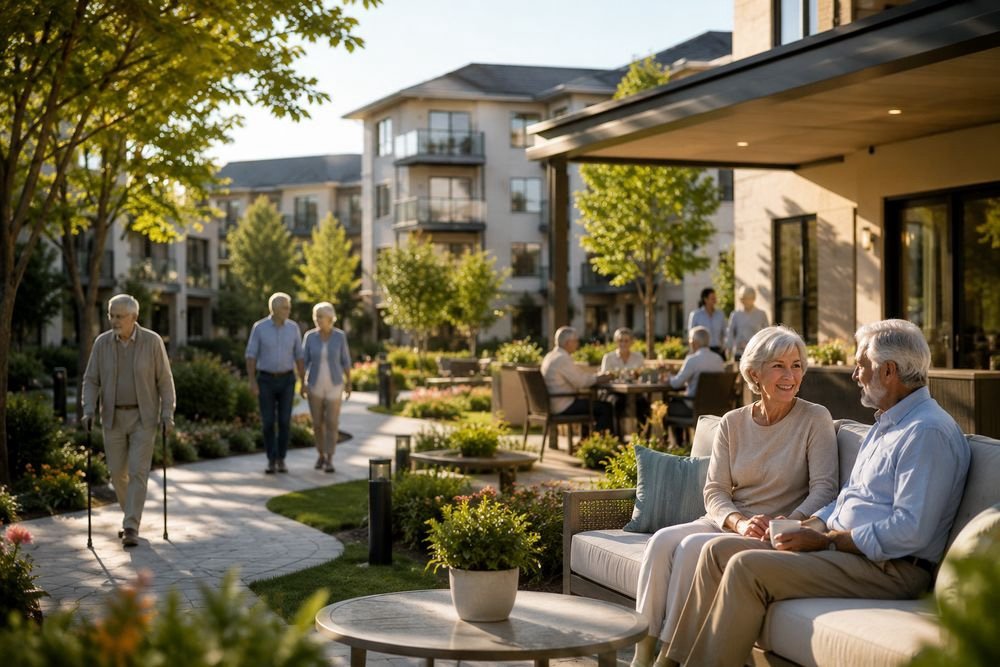

American Healthcare REIT and Chartwell Show How Longevity Is Turning Senior Housing into One of the Most Attractive Assets of the New Real Estate Cycle
Senior living is sending an increasingly difficult signal for investors, developers and major real estate groups to ignore: demand, occupancy, revenue, earnings and institutional investment are rising at the same time. The latest results from two major North American operators, American Healthcare REIT and Chartwell Retirement Residences, provide an especially clear picture. American Healthcare REIT reported 13.2% year-on-year growth in same-store NOI across its portfolio, while its Senior Housing Operating Properties — SHOP — segment increased by an impressive 20.5%. The company has accumulated approximately $1.4 billion in new investments during 2026 and, following the end of the quarter, completed the acquisition of another 10 SHOP assets for approximately $1 billion. Its investment pipeline exceeds $800 million, it has approximately $2.6 billion in liquidity, and it has raised its 2026 Normalized Funds From Operations guidance to $2.15-$2.19 per share, which would represent growth of more than 25% compared with the previous year. At the same time, in Canada, Chartwell Retirement Residences reported quarterly property revenue of C$320.4 million, up 19.5% year on year, while FFO increased 34% to C$90.5 million. FFO per unit increased by 16.7%, extending the company’s record to 12 consecutive quarters of double-digit growth, while same-property occupancy reached an exceptional 94.3%, 320 basis points above the previous year.
The figures become even more compelling when considered together. American Healthcare REIT demonstrates the intensity with which institutional capital is entering the category, while Chartwell confirms that senior living assets can achieve high occupancy alongside strong operational growth. Chartwell increased its operating margin to approximately 42.5%, while same-property NOI grew 11.9%. The company is not simply managing existing demand: it is preparing four new developments that will add 828 suites, acquired an interest in a portfolio of 23 communities comprising 2,943 suites, and recently agreed to acquire another retirement residence in the Toronto area for approximately C$136 million. American Healthcare REIT, meanwhile, is using its financial capacity to build scale through acquisitions. When one company can invest around $1.4 billion in a year, maintain $2.6 billion in liquidity and continue identifying hundreds of millions of dollars in additional opportunities while another major operator exceeds 94% occupancy, the strategic interpretation goes far beyond two strong quarterly reports: senior living is entering a period in which demographic growth is increasingly translating into financial performance and institutional capital deployment.
The Explanation Is Demographic: The Decade of 80-Year-Old Baby Boomers Has Begun
The fundamental driver behind this transformation is not a temporary real estate trend. In 2026, the oldest US baby boomers, born in 1946, turn 80, beginning a demographic transition that will continue for almost two decades. The American baby-boom generation generally includes people born between 1946 and 1964, meaning that millions of individuals will progressively move every year into age groups where demand for adapted housing, services, assisted living, memory care and home support tends to increase. The effect will not be immediate or uniform: most people aged 65, and even many in their 70s, do not live in senior housing and can remain independent for decades. But the market does not require an entire generation to use these services to generate enormous growth. Even a relatively small percentage of such a large demographic cohort moving into specialised housing can place substantial pressure on available supply.
US occupancy data reinforce this argument. NIC MAP has reported senior housing occupancy across major US markets at around 90% during 2026, returning towards levels not seen since before the global financial crisis, while the volume of units under construction remains historically low. This combination is particularly powerful: demand is increasing precisely when the industry’s ability to add supply has been constrained. Higher interest rates, construction costs, financing availability, land prices and regulatory complexity have discouraged development during recent years. Because a senior housing community can require several years from planning through construction to opening, supply cannot respond immediately when demand accelerates.
Limited New Supply Could Become One of the Market’s Greatest Catalysts
High occupancy is attractive in any property market. High occupancy combined with limited construction creates an even stronger dynamic for owners of existing assets. If the target population expands while relatively few new units enter the market, well-positioned operators can increase occupancy, improve pricing and spread fixed costs across a larger resident base. This helps explain why Chartwell’s results show simultaneous increases in revenue, NOI, margins and FFO.
This strength could eventually trigger a new development cycle as institutional capital returns to the sector. The critical issue will be speed. Developing senior living is considerably more complex than constructing conventional apartments because the asset combines real estate with hospitality, services and, in certain categories, healthcare. Locations must work for residents and their families; buildings need to support accessibility and mobility; operators must recruit specialised employees; and regulatory requirements can be considerably more demanding.
Existing assets with strong locations and experienced operators therefore become strategically valuable.
Buying can be considerably faster than building.
This is one of the forces behind the billion-dollar acquisitions now taking place across the sector.
Institutional Capital Is No Longer Simply Buying Care Homes
American Healthcare REIT illustrates a broader transformation. Major investors are not entering senior housing simply because a building generates rent. They increasingly want operating platforms capable of increasing occupancy, improving revenue per resident, controlling costs and acquiring additional assets. Modern senior living combines real estate + hospitality + healthcare + technology + recurring services, creating multiple layers of economic value around the same resident.
An individual may pay for accommodation, food, activities, transportation, wellness, rehabilitation, healthcare, personal assistance and progressively more specialised services. The economic model therefore resembles a service platform built around a real estate asset more than conventional residential rental property.
This also explains why margins can improve rapidly as occupancy rises. Many of the costs associated with operating the property exist whether a room is empty or occupied. Adding residents can generate incremental revenue without every cost increasing proportionally. The result is powerful operating leverage as a community moves, for example, from 85% occupancy towards 90% or 95%.
Chartwell’s 94.3% Occupancy Shows Where the Next Competitive Battle Begins
Occupancy of 94.3% changes business priorities. When many units are vacant, the primary objective is customer acquisition. When a property approaches full occupancy, the question becomes how much additional value can be created for each resident. This opens a new phase for the industry in which wellness, personalised nutrition, physiotherapy, prevention, cognitive programmes, premium services, transportation, experiences, technology and healthcare can become additional sources of revenue.
The traditional retirement residence can consequently evolve towards a Longevity Community. Instead of waiting until residents require more intensive care, communities can invest in maintaining independence through strength training, fall prevention, nutrition, cognitive health, social interaction and monitoring. There is a particularly interesting economic alignment: if residents preserve their health and independence, their quality of life improves while operators may also reduce some of the complications and costs associated with higher levels of dependency.
Technology will become central to this transformation. Sensors, wearables, artificial intelligence, telemedicine and predictive systems can help identify changes in mobility, sleep, behaviour or health. The objective is not to fill a residence with gadgets. It is to transform data into interventions that allow residents to remain independent for longer.
From Senior Living to Longevity Real Estate
The strength of the market is also encouraging a much broader definition of the category. The opportunity does not end with traditional care homes. It can include active adult communities, independent living, assisted living, memory care, continuing care retirement communities, cohousing, intergenerational housing and homes designed for aging in place.
This emerging universe can be grouped under a more ambitious concept: Longevity Real Estate, the property infrastructure required for a society in which millions of people will live into their 90s and potentially beyond 100.
A 55-year-old may not require senior living for decades but may already want an accessible, efficient home capable of adapting over time. At 70, community services may become more attractive. At 80, home support could become necessary. At 90, assisted living or memory care may eventually be required. If the property industry can support the customer throughout that journey, lifetime customer value could extend across several decades.
The Greatest Constraint Could Be Labour: Buildings Can Be Constructed, Caregivers Cannot Simply Be Manufactured
There is, however, one major limitation capable of restricting this growth. A building can be financed and constructed, but a senior living community cannot operate without people. Nurses, nursing assistants, caregivers, physiotherapists, activity professionals, hospitality teams and maintenance employees are all part of the experience. Labour shortages already affecting the United States, Canada, Europe and Asia could become the greatest bottleneck for senior living.
Technology will therefore be required not only to improve the resident experience but also to increase workforce productivity. AI-assisted documentation, automated scheduling, process optimisation, remote monitoring and robotics can release working hours. Operators capable of reducing employee turnover, improving working conditions and automating administrative tasks will possess a structural advantage.
The future profitability of an asset may depend as much on its ability to attract employees as on its ability to attract residents.
Senior Living Is Becoming Relevant to the Entire Financial Ecosystem
The arrival of REITs, private equity, insurers and other institutional investors could also transform the structure of the industry. Senior living remains relatively fragmented in many countries, with numerous regional and family-owned operators. Institutional capital increases the ability to acquire portfolios, standardise processes, deploy technology and professionalise revenue management.
New financial vehicles focused specifically on longevity may also emerge. Real estate funds, private debt, joint ventures between operators and insurers, and investment structures linked to care infrastructure could attract capital from investors seeking exposure to long-term demographic trends.
Unlike a technology trend that may disappear within several years, the ageing of a generation that has already been born offers unusually high demographic visibility.
We know approximately how many people will turn 80 in ten years because those people already exist today.
Europe Should Watch the North American Market Very Closely
The same transformation will progressively reach Europe. Spain, Italy, Germany, France and other markets combine high life expectancy with rapidly ageing populations. Yet the availability and structure of housing for older people differ enormously between countries, and there remains a substantial gap between remaining in a conventional private home and moving into a traditional care facility.
This gap could represent one of the largest opportunities: active-adult communities, urban senior living, premium cohousing, housing with optional services and intergenerational developments. The European consumer aged 65 or 70 in the future is likely to demand a very different product from the care facilities used by previous generations.
Capital that understands this transformation early can build assets designed for demand that could continue expanding for decades.
The Strength of Senior Living Can Now Be Measured Through Five Indicators
The results from American Healthcare REIT and Chartwell allow the current strength of the sector to be summarised through five powerful signals: occupancy around or above 90%, double-digit NOI growth across selected portfolios, expanding FFO, billion-dollar acquisitions and limited new supply. When these factors coincide with millions of baby boomers moving into advanced age groups, the investment thesis stops being purely demographic and begins to become financial.
This does not mean every senior living property is automatically an attractive investment. The sector continues to face substantial risks, including labour costs, regulation, resident affordability, inflation, financing conditions, reputation and quality of care. Operator selection and location remain critical.
But the structural direction is becoming increasingly clear.
Senior living is no longer being viewed exclusively as a care response to population ageing.
It is becoming essential infrastructure for the Longevity Economy.
And the latest results from American Healthcare REIT and Chartwell suggest that institutional capital has already begun positioning itself for that transformation.
Prepare to Lead the Longevity Economy
Senior living, Longevity Real Estate, AgeTech, preventive healthcare and new service models for people over 50 are creating some of the most compelling business opportunities arising from global demographic transformation. The MBA in Longevity Business by FIFTIERS prepares entrepreneurs, investors and executives to identify these emerging markets and develop strategies capable of turning longer lives into new business models.
Discover more from FIFTIERS
Subscribe to get the latest posts sent to your email.
What's Your Reaction?