





THE 100 MOST INFLUENTIAL FIFTIERS OF THE WORLD — Global Ranking 2027 #003 | Jeff Bezos: at 62, the entrepreneur placing his capital behind industries that barely exist yet

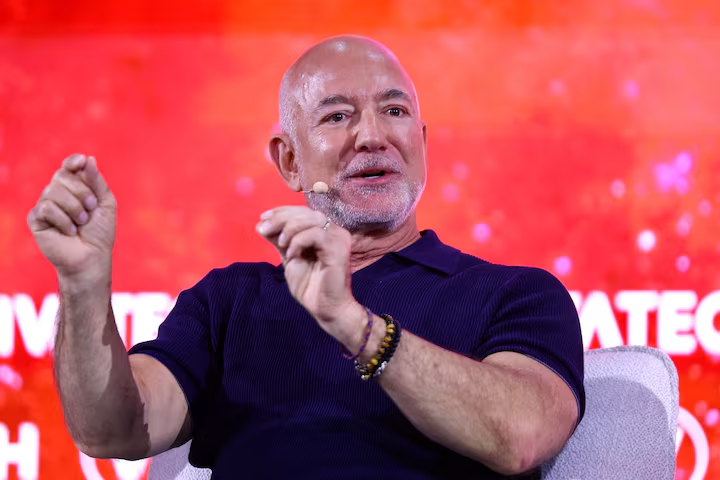

For decades, Jeff Bezos was described as the man who transformed commerce. That definition is becoming increasingly inadequate. At 62, the Amazon founder is entering what may ultimately prove to be an even more consequential period of his career than the one that began when he founded the company in 1994. He no longer runs Amazon day to day, although he remains executive chairman. Instead, his capital, time and influence are converging around an extraordinary combination of artificial intelligence, space exploration, biotechnology, longevity, climate and future infrastructure. As of September 4, 2026, Forbes estimated his fortune at approximately $266.9 billion, ranking him as the third-richest person in the world.
Yet wealth alone would never be enough to justify inclusion in THE 100 MOST INFLUENTIAL FIFTIERS OF THE WORLD — Global Ranking 2027. What makes Bezos particularly compelling is what he is choosing to do with the intervention capacity that such wealth creates. His recent trajectory reveals an unusual pattern among the world’s largest fortunes: he is allocating resources toward problems that may take decades to solve and toward markets that, in several cases, are only beginning to form.
Longevity offers one of the clearest examples. Bezos was reported in 2021 to be among the investors backing Altos Labs, the biotechnology company built around cellular rejuvenation research. When Altos formally launched operations in 2022, it announced $3 billion in financing, an extraordinary level of funding for a scientific organization whose initial objective was not rapid commercialization but understanding how cellular health and resilience might be restored to reverse disease, injury and disability. Altos continues to work on cellular rejuvenation, epigenetic reprogramming, computational biology and generative models for biological systems.
The importance of that bet extends far beyond one company. The great economic leap in longevity will not necessarily arrive with a supposed single “cure for aging.” It may arrive when the vast pools of capital that previously transformed software, the internet and artificial intelligence begin treating human biology as a technological platform that can increasingly be understood, modeled and potentially modified. The arrival of Bezos and other major investors helped change the perception of the field. Altos became emblematic of a broader transition: from aging research being concentrated primarily inside universities and laboratories to private organizations capable of deploying billions of dollars in an effort to turn fundamental discoveries into medicine. The Financial Times described the launch of Altos as a coming-of-age moment for the business of extending healthy youth.
For FIFTIERS, this is central to his candidacy. Jeff Bezos is helping bring planetary-scale capital into the longevity economy. He is not an aging scientist and does not present himself as one. His leverage lies elsewhere: in the ability to give exceptional researchers time, infrastructure, computation and funding to pursue questions conventional capital might regard as too distant. In an industry where scientific cycles can extend for a decade or longer, that kind of financial patience can alter what becomes possible.
His ambitions now stretch well beyond longevity. In 2026, Bezos returned to a frontline operating role as co-founder and co-CEO of Prometheus, a new artificial intelligence company focused on engineering and the physical world. Forbes reported in September 2026 that the business had completed financing at a $41 billion valuation. Speaking at VivaTech in Paris, Bezos presented a deeply expansionary interpretation of AI: not as a technology destined to make humans redundant, but as one capable of lowering barriers to designing, building and creating.
The longevity connection is again indirect but potentially enormous. The next generation of computational biology, drug discovery, molecular design, autonomous laboratories, medical devices and assistive robotics will increasingly depend on artificial intelligence systems capable of understanding and manipulating the physical world. The convergence of AI and biotechnology could become one of the foundational infrastructures of the longevity economy during the 2030s. Bezos is positioning capital on both sides of that convergence.
Then there is Blue Origin, founded around an exceptionally long-term objective: building space infrastructure that could eventually enable millions of people to live and work beyond Earth. Its stated mission includes radically reducing the cost of accessing space through reusable systems. And the ambition is steadily moving from narrative to infrastructure. On September 2, 2026, Blue Origin announced that NASA had selected it to develop a Mars Telecommunications Orbiter, intended to become part of the communications architecture connecting Earth and Mars.
His time horizon explains much about the Bezos strategy. While most corporations work around quarterly objectives and governments around electoral cycles, many of his personal bets operate across decades. Amazon transformed how people shop. AWS changed the infrastructure of enterprise computing. Blue Origin wants to change where civilization can operate. Altos Labs is investigating whether forms of cellular deterioration can be reversed. Prometheus is applying AI to the creation of the physical world. And the Bezos Earth Fund, established with an initial $10 billion commitment, is financing science, conservation, energy, food systems and climate technologies internationally.
Viewed together, this no longer resembles the portfolio diversification of a billionaire. It resembles a thesis about the twenty-first century: more intelligence, greater industrial capability, better health, more space and a more resilient planet.
There is also something quintessentially FIFTIERS about Bezos’s current chapter. At 62, he could simply manage one of the greatest private fortunes ever created. Instead, he has returned to an executive operating role, continues to fund frontier technologies and is pursuing projects whose full outcomes may not be measurable for another twenty or thirty years. His example directly challenges the outdated assumption that professional impact should peak before 50.
The emerging architecture of global power suggests the opposite. In industries where capital, experience, networks, credibility and the ability to absorb risk matter as much as speed, people in their 50s, 60s and 70s may be entering precisely the period when they possess the greatest capacity to reshape the world around them.
FIFTIERS EDITORIAL VERDICT: Jeff Bezos deserves consideration among the leading candidates for THE 100 MOST INFLUENTIAL FIFTIERS OF THE WORLD — Global Ranking 2027 because very few individuals combine comparable financial resources, entrepreneurial capability, technological ambition and a multi-decade horizon. His influence can no longer be measured through Amazon alone. It now extends across artificial intelligence, biotechnology, longevity, space, climate and the infrastructure of future economies. His ultimate legacy may therefore prove larger than building one of history’s most powerful corporations: it may be using the wealth created by that company to finance industries capable of changing how long we live, how we work and where future generations of humanity may ultimately thrive.
Discover more from FIFTIERS
Subscribe to get the latest posts sent to your email.
What's Your Reaction?