






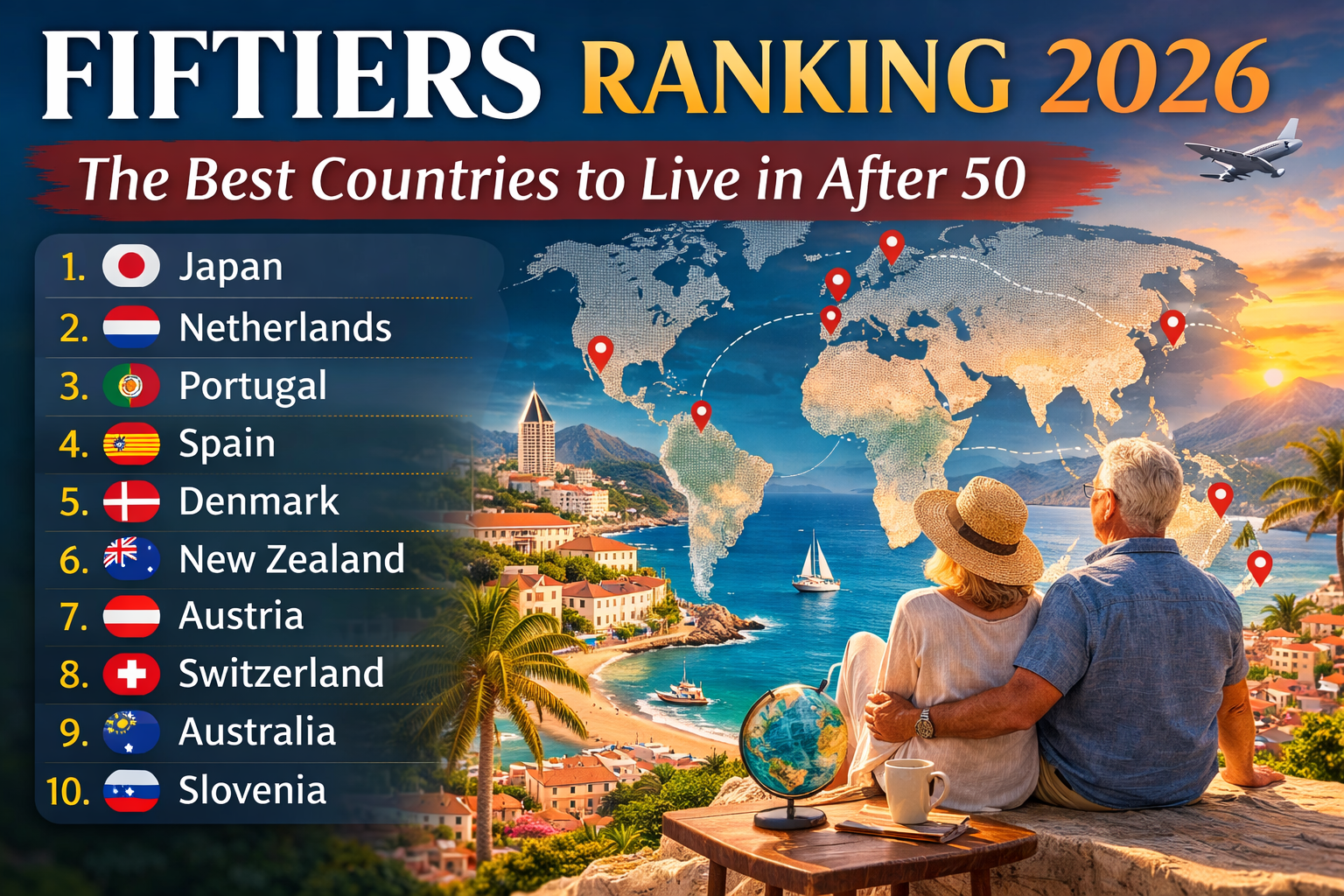
FIFTIERS RANKING 2026: Best Countries to Life After 50


FIFTIERS | Life Begins at 50. La vida comienza a…
There are rankings designed for investors, others for expatriates, and others for retirees with substantial wealth. This one comes from a different place. The FIFTIERS Ranking 2026 starts with a far more human and useful question: which countries offer the best life after 50 for people seeking health, safety, economic balance, a good climate, and a real chance to remain active.
To build it, we used the current 2026 Numbeo comparative indexes for healthcare, safety, cost of living, and climate, together with international references on senior employment from the OECD and peace and stability from the 2025 Global Peace Index.
The logic behind this ranking is simple. After 50, living well is no longer determined only by salary or by a country’s GDP. What begins to matter more is the quality of the healthcare system, the sense of safety when walking outside, the ability to maintain a good standard of living without every aspect of life becoming excessively expensive, the kind of climate that supports daily energy and well-being, and, increasingly, the possibility of continuing to work, start something new, or reinvent oneself professionally. The OECD has been pointing out for years that employment rates for people over 55 have continued to rise across much of the developed world, which completely changes the traditional idea of the second half of life.
It is also important to make one thing clear from the start: this ranking does not measure only where to retire, but where to live well with quality and with a future. That is why some very wealthy countries do not appear as high as one might expect, while others, less dazzling in terms of income, rise in the ranking because they offer a far more intelligent combination of daily well-being and overall stability. The final result favors countries that balance the five factors most effectively, not those that excel in only one.
1. Japan: the most complete country for a long, safe, and active life
Japan takes first place because it brings together something very few countries manage to achieve: excellent healthcare, very high safety, reasonable costs for an advanced economy, and a culture in which aging does not mean disappearing from professional life. In Numbeo 2026, it shows a Health Care Index of 80.1, a Safety Index of 77.2, a Cost of Living Index of 47.5, and a Climate Index of 83.8, an extraordinarily strong combination. In addition, the World Bank places Japan among the countries with the highest life expectancy on the planet, while the WHO continues to rank it strongly in terms of healthy life years.
To that foundation we must add another advantage, one less discussed but decisive for FIFTIERS: Japan continues to integrate older people into economic life. The OECD highlights very high employment rates among people aged 55 to 64, making the country a benchmark for those who do not view their 50s, 60s, or 70s as a period of withdrawal, but as a time of continuity, experience, and reinvention. Japan also appears among the most peaceful countries in the world in the 2025 Global Peace Index, reinforcing its image as a stable and predictable place to live.
2. The Netherlands: a machine of well-organized quality of life
The Netherlands ranks second because it is one of the countries that has best transformed institutional quality into daily quality of life. In Numbeo 2026, it appears directly as number one in the world in the Quality of Life Index, with a score of 213.6, supported by a Health Care Index of 81.5, a Safety Index of 74.5, a Climate Index of 86.9, and very high purchasing power. It is not a cheap country, but it is one of those that best converts cost into services, order, mobility, and real well-being.
For a person over 50, the Netherlands has a particularly powerful advantage: it allows people to continue living with autonomy, structure, and professional prospects. OECD references place the country among the strongest in employment for people over 55, while the Global Peace Index places it within the core group of the most peaceful and stable countries in the world. The result is a highly attractive ecosystem for senior profiles who value both health and safety as well as the possibility of staying active without excessive friction.
3. Portugal: exceptional climate, moderate costs, and social calm
Portugal reaches the podium for a very simple reason: it offers a very high quality of life without demanding the budget of northern European countries. Its Climate Index of 97.8 is among the best in the world, its Cost of Living Index of 48.8 is competitive, and it maintains very respectable levels of safety and healthcare within the European context. In a ranking designed for real life after 50, that balance is immensely valuable.
But Portugal is not just about climate and lower costs. The country ranks among the best in the 2025 Global Peace Index and has also improved labor market integration for mature adults. That makes it a very serious option for those who want to live in a gentle, welcoming, relatively affordable environment with a sense of serenity that is difficult to find in more aggressive or more expensive markets. Portugal does not dominate every variable, but overall it is one of the smartest countries in the world for living well after 50.
4. Spain: a powerhouse of longevity and everyday quality of life
Spain comes in fourth, although for many people it will feel emotionally and practically like a podium country. Few places combine high life expectancy, good healthcare, an outstanding climate, and a still-reasonable cost of living so effectively. Numbeo 2026 gives it a Climate Index of 92.8, a Health Care Index of 77.2, and a Cost of Living Index of 51.6, while international data continue to place it among the countries with the highest longevity in the world.
Why is it not higher? Mainly for two reasons. The first is that its perception of safety remains below Japan, the Netherlands, or Denmark. The second is that, although senior employment has improved, Spain does not reach the level of the leading countries in opportunities for people over 55. Even so, when the full experience of living is measured — climate, social life, daily rhythm, health, food, urban life, and costs that remain relatively under control — Spain continues to be one of the most attractive places on the planet for the FIFTIERS generation.
5. Denmark: Nordic well-being with a high price, but with unquestionable strength
Denmark ranks fifth and represents the European ideal of institutional well-being very well. Numbeo 2026 assigns it a Quality of Life Index of 212.2, a Safety Index of 73.8, a Health Care Index of 77.2, and extraordinarily strong purchasing power. It also appears among the top countries in the 2025 Global Peace Index, reinforcing its profile of stability, predictability, and order.
Its limitation is cost. With a Cost of Living Index of 78.9, living in Denmark requires far greater financial capacity than in Portugal, Spain, or Japan. That is why it does not rise higher in a ranking that seeks balance rather than theoretical excellence alone. Even so, for a person over 50 who values strong institutions, safety, civility, public services, and continued participation in the workforce, Denmark remains a top-tier benchmark.
6. New Zealand: peace, open air, and a mature life with space
New Zealand enters in sixth place and does so with arguments very different from those of Europe. It is one of the most peaceful countries on the planet, according to the 2025 Global Peace Index, and it has a Climate Index of 97.2, one of the highest figures in the comparative ranking. In addition, labor statistics place it among the countries with the best employment rates in later working ages, which fits perfectly with a vision of active longevity.
It is not higher because its comparative evaluation in perceived safety and healthcare does not reach the level of Japan or the leading European group. Even so, New Zealand remains a great option for those who prioritize calm, nature, open air, low social tension, and the possibility of continuing to live with purpose in the second half of life. It is less urban and less dense, but that is precisely part of its appeal.
7. Austria: Central European order, strong structural safety, and very good healthcare
Austria maintains a very strong position thanks to robust healthcare, good safety, and a level of general stability that is difficult to question. In Numbeo 2026, it records a Health Care Index of 78.9, a Safety Index of 71.5, and a Cost of Living Index of 71.3. Added to that, the 2025 Global Peace Index places it among the most peaceful countries in the world, something especially valuable for those who prioritize predictability and calm.
Austria falls to seventh place because its climate cannot compete with the Mediterranean advantage and because, in senior opportunities, it does not advance at the pace of the most dynamic leaders. Even so, it remains an excellent option for those seeking a serious, well-managed, comfortable country to live in, with high standards across nearly every dimension. Austria may not seduce in the same way as Portugal or Spain from a climate perspective, but it is extremely convincing when one analyzes the structure.
8. Switzerland: total excellence, except for one decisive factor, cost
Switzerland could compete for a podium place in safety, stability, income, and overall performance. Numbeo 2026 gives it a Quality of Life Index of 206.2, a Safety Index of 72.6, and outstanding purchasing power, while the 2025 Global Peace Index keeps it among the most peaceful countries in the world. For a person over 50, that means reliable institutions, a very safe environment, and an exceptionally efficient country structure.
So why is it only eighth? Because its Cost of Living Index of 110.7 breaks the balance. In a ranking designed not only for millionaires but for people who want to live extremely well without turning daily life into an exercise in extreme spending, Switzerland loses ground to countries that are far more efficient in the relationship between quality and cost. It is excellent, but not the smartest option for most people.
9. Australia: sun, health, and opportunities, with rising costs
Australia remains in the top 10 because it is still one of the most attractive advanced economies for those who value climate, outdoor life, and professional continuity. Numbeo 2026 gives it a Climate Index of 91.9, a Health Care Index of 72.0, and a very competitive quality-of-life profile. In addition, senior employment references place it among the countries performing well for mature age groups.
Its limitation lies in two areas. The first is cost, which is now clearly high. The second is that its comparative perception of safety is not as strong as in Japan, Switzerland, Austria, or Denmark. Even so, for those who value space, climate, dynamism, and a culture of physical well-being, Australia remains a strong option for living after 50 with energy and continuity.
10. Slovenia: the quiet surprise of the ranking
Slovenia closes the top 10 and does so as one of those countries that rarely dominates conversations but solves real life extremely well. Numbeo 2026 assigns it a Safety Index of 75.5, one of the highest in the group, together with a Cost of Living Index of 54.1, still quite contained, and a reasonable climate profile for the European context. The 2025 Global Peace Index also places it among the most peaceful countries in the world.
It does not rise higher because its healthcare and its opportunities for people over 55 do not reach the level of the leaders. But that is precisely what makes it so interesting: it shows that a country does not need to be gigantic or ultra-wealthy to offer safety, calm, and a comfortable life after 50. Slovenia is a very intelligent option for those who value discretion, stability, and a strong relationship between quality of life and cost.
The countries just outside the top 10
Finland, Iceland, Luxembourg, and Germany come close, but do not make the final list for different reasons. Finland shines in safety and healthcare, but its climate clearly penalizes it in a ranking focused on pleasant living after 50. Iceland is a superpower in peace, but its costs are very high. Luxembourg offers an enormous level of prosperity, though with strong price pressure. Germany, for its part, preserves a solid structure, but does not offer the same climatic and emotional balance as the leaders of the ranking.
The FIFTIERS conclusion
The great lesson of this ranking is that the best life after 50 is not found only in the richest countries, but in those that combine health, serenity, climate, safety, reasonable costs, and opportunities to continue having purpose. That is why Japan leads, why the Netherlands impresses, and why Portugal and Spain shine so brightly when the focus shifts away from money alone and toward real life.
Looking ahead, everything suggests that the true luxury for the FIFTIERS generation will be living in countries where longevity does not come hand in hand with isolation, fear, or uncontrolled spending, but with health, horizons, everyday quality, and the freedom to continue enjoying life and contributing. And in that new geography of well-being, these ten countries start with a clear advantage.
Discover more from FIFTIERS
Subscribe to get the latest posts sent to your email.
What's Your Reaction?