




Singapore Moves First: SMU Launches a Global Longevity Institute to Redesign the Economy of the Future


FIFTIERS | Life Begins at 50. La vida comienza a…
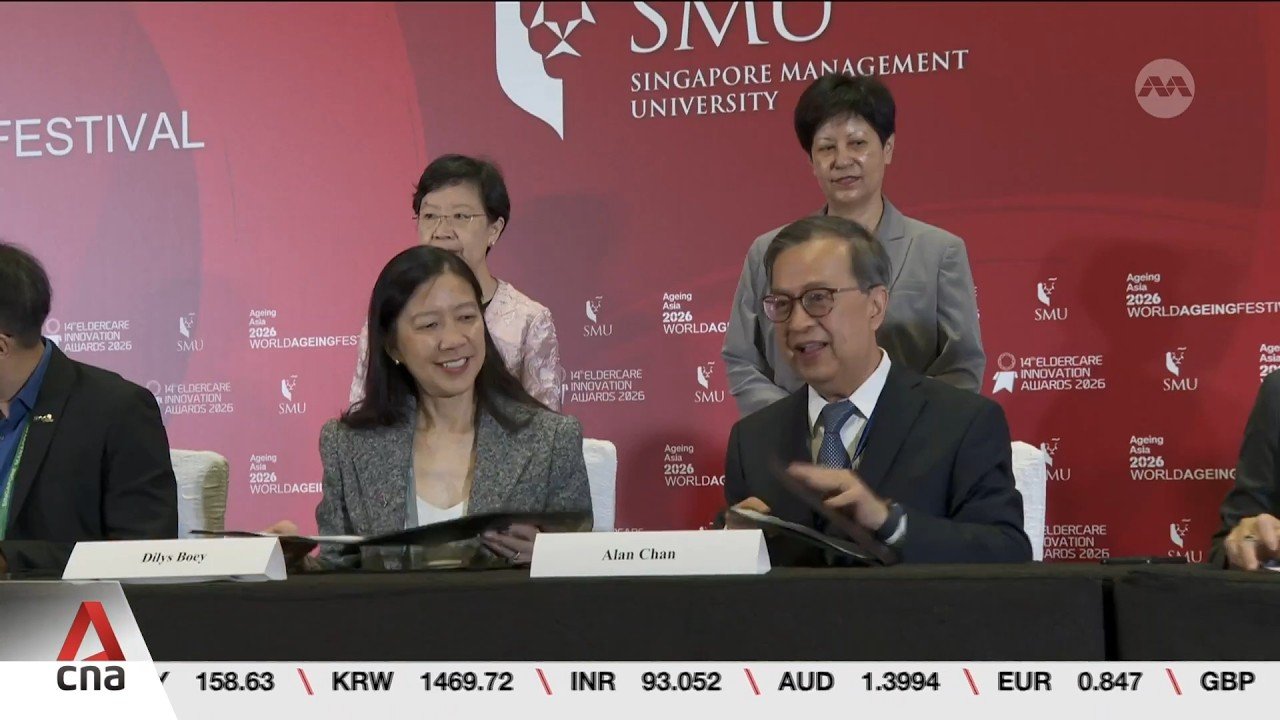
The decision by Singapore Management University (SMU) to launch the SMU Longevity Societies and Economies Institute is not a simple university announcement nor just another academic initiative within the Asian ecosystem. It is, in reality, a signal of where economic, institutional, and demographic power in the 21st century is heading. The institute was officially presented on April 14, 2026, within the framework of the World Ageing Festival 2026, with institutional backing from the Government of Singapore, and is born with a clear mandate: to generate knowledge, innovation, and applied proposals to help Singapore and other economies adapt to the transition toward longer-living societies.
What is truly relevant is not only the name of the center, but the context in which it appears. Singapore is no longer speaking about ageing as a peripheral issue linked to dependency or public spending, but as a structural phenomenon that requires redesigning work, support systems, housing, financial markets, healthcare innovation, urban organization, and the very architecture of growth. That shift in language matters. When one of the most sophisticated and strategically planned economies in the world creates a specific institute to study the longevity economy, it is acknowledging that ageing is not an extension of social policy: it is the new center of gravity of the economic system.
The data that explains everything is striking. According to official figures from Singapore, in 2025, 20.7% of its citizens were already aged 65 or older, compared to 13.1% in 2015. And the country’s own public projections indicate that by 2030 this proportion will reach 23.9%, meaning approximately one in four citizens. This is not a remote hypothesis, but a transformation already underway, unfolding at a very high speed by the standards of public policy, labor markets, and business planning.
Moreover, the official narrative at the launch went even further. Minister Indranee Rajah recalled that just ten years ago around one in eight Singaporeans was aged 65 or over; today it is around one in five, and “by the turn of the next decade” it will be one in four. She added another data point of enormous strategic value: within approximately fifteen years, one in three seniors in Singapore will be aged 80 or older. This implies that the debate is no longer only about how many people are ageing, but also about how they age, how long they live, and what pressure or opportunity they generate for healthcare, consumption, savings, employment, mobility, and assistive technology.
From this perspective, SMU’s new institute arrives at exactly the right moment. Because longevity can no longer be analyzed solely through the lens of gerontology or public health. It requires a transversal, economic, and business-oriented perspective. In fact, the institute’s own framework makes this clear: its focus includes work, pensions, markets, wellbeing, and technology—five domains that together describe almost the entire backbone of a modern economy.
In the labor sphere, longevity forces a complete reassessment of the traditional social contract. Developed economies have for decades been designed around a relatively linear logic: education in youth, intensive employment in adulthood, and retirement in old age. That model begins to lose relevance as life expectancy increases, functional health improves at older ages, careers become fragmented, and the need to update skills becomes permanent. The question is no longer simply how to retire a larger population, but how to structure longer, more flexible working trajectories compatible with health, care, and productivity. The SMU ecosystem itself has emphasized, following the launch, the need to “rethink work” and support systems in a longevity-driven society.
In pensions and public finances, the challenge is even deeper. If an increasing share of the population lives longer, and also spends more time outside traditional employment or moves in and out of different work phases, contribution formulas, savings systems, retirement models, and investment strategies must be redesigned. It is not enough to delay retirement ages or increase contributions; new financial products, new protection structures, and new incentives are required so that longevity does not become a chronic fiscal pressure. The fact that a business-oriented university like SMU elevates this issue to institutional priority suggests that Singapore does not want to react late: it intends to shape that future before it becomes unmanageable.
In markets and consumption, the implications are immense. A society in which nearly a quarter of the population is over 65 does not consume in the same way, does not save in the same way, does not move in the same way, and does not value product attributes in the same way. Housing, urbanism, retail, tourism, mobility, nutrition, preventive medicine, home technology, banking, insurance, and even entertainment are all transformed. The longevity consumer is not a small niche nor a care-based market. It is increasingly one of the main drivers of aggregate demand. The creation of the institute can be interpreted as an attempt to equip companies, regulators, and investors with a roadmap to capture this new economic reality before other countries do. This is a strategic inference based on the declared scope of the center and Singapore’s demographic structure.
All of this becomes even more powerful when viewed at the Asian scale. Asia is not entering the ageing era: it is becoming its global epicenter. According to UNFPA Asia-Pacific, the number of older people in Asia-Pacific will triple, reaching 1.3 billion by 2050. The same organization notes that by mid-century, one in four people in the region will be aged 60 or older, and in East and Northeast Asia the proportion will be even higher, with one in three people over 60. Another regional reference used in United Nations forums indicates that in 2020, around 60% of the world’s older population—some 630 million people aged 60 or more—lived in Asia-Pacific.
This completely reshapes the geoeconomic landscape. If Asia concentrates the largest ageing population in the world, it will also concentrate a growing share of spending on healthcare, care services, assistive technology, adapted housing, financial services for seniors, lifelong learning, wellbeing, and products linked to personal autonomy. In other words, a large part of the future longevity economy will be decided in Asia. It is therefore logical that Singapore aims to position itself intellectually and strategically at the center of that conversation. The country has spent years establishing itself as a hub for regulatory, financial, and technological innovation in highly complex fields. It now seeks to do the same with longevity.
There is another factor that makes this development even more powerful: Singapore’s nature as a public policy laboratory. This is not a large and disorganized country, but an economy with a high capacity for coordination between government, academia, business, and regulation. When Singapore detects a structural transition, it typically responds by creating institutions, pilot programs, regulatory frameworks, and alliances. In this sense, the Longevity Societies and Economies Institute should not be interpreted solely as a research center, but as a platform to incubate models transferable to public policy, the financial sector, insurers, the technology industry, and the broader business ecosystem. This interpretation is supported by the institute’s own positioning as a driver of knowledge and innovation for Singapore’s “longevity transition.”
It is also worth emphasizing that the language of “societies and economies” is highly revealing. The focus is not only on individual longevity or healthy ageing, but on societies and economies as a whole. In other words, the phenomenon is approached as a collective and systemic transformation. This opens the door to lines of work that go far beyond medicine: redesigning cities, intergenerational models, new professional credentials for second and third careers, hybrid care systems, adapted real estate markets, banking services tailored to longer lifespans, and wellbeing platforms that combine prevention, monitoring, and functional autonomy. All of this aligns with the institute’s stated priorities.
From a business perspective, this development has an immediate reading. Companies that continue to design products, services, customer experience, labor policies, and value propositions with an excessively youth-centric bias will be left out of the next major wave of growth. Longevity does not only create more demand for healthcare; it creates demand for redesign across virtually all sectors. The company that understands this shift first will be able to build brands, channels, solutions, and narratives adapted to a longer-living population with extended consumption cycles and far more complex life trajectories. Those that fail to understand it will continue operating with demographic maps from the last century. This conclusion is analytical, but it is strongly supported by official demographic trends and by the creation of this institute with an explicitly economic mandate.
There is also a silent geopolitical dimension behind SMU’s move. Those who dominate applied knowledge on longevity will dominate part of the regulatory design, capital flows, talent, and future standards in one of the largest markets of the century. Just as occurred with digitalization, sustainability, and artificial intelligence, countries and institutions that first build solid reference frameworks will be able to influence how investment is allocated and how industries are structured. Singapore appears to have decided that it does not want to wait for others to define that framework. It wants to help write it.
This development must therefore be understood in its full dimension. This is not a university inaugurating a thematic center to gain visibility. This is an advanced economy officially recognizing that population ageing can no longer be treated as a secondary issue, and that it requires new responses across work, savings, innovation, wellbeing, and competitiveness. Singapore is sending a message to the world: longevity will not be a secondary social issue, but one of the major economic battlegrounds of the coming decades.
The final strategic reading is clear. This is not academic research. It is institutional preparation for a new economy. When a country that plans with surgical precision creates an institute of this nature precisely at a moment when its population aged 65 and over is approaching 23.9%, and when Asia is heading toward 1.3 billion people aged 60 or more by 2050, the message is unequivocal: the future of growth, consumption, employment, and wellbeing will be deeply shaped by longevity.
Discover more from FIFTIERS
Subscribe to get the latest posts sent to your email.
What's Your Reaction?