


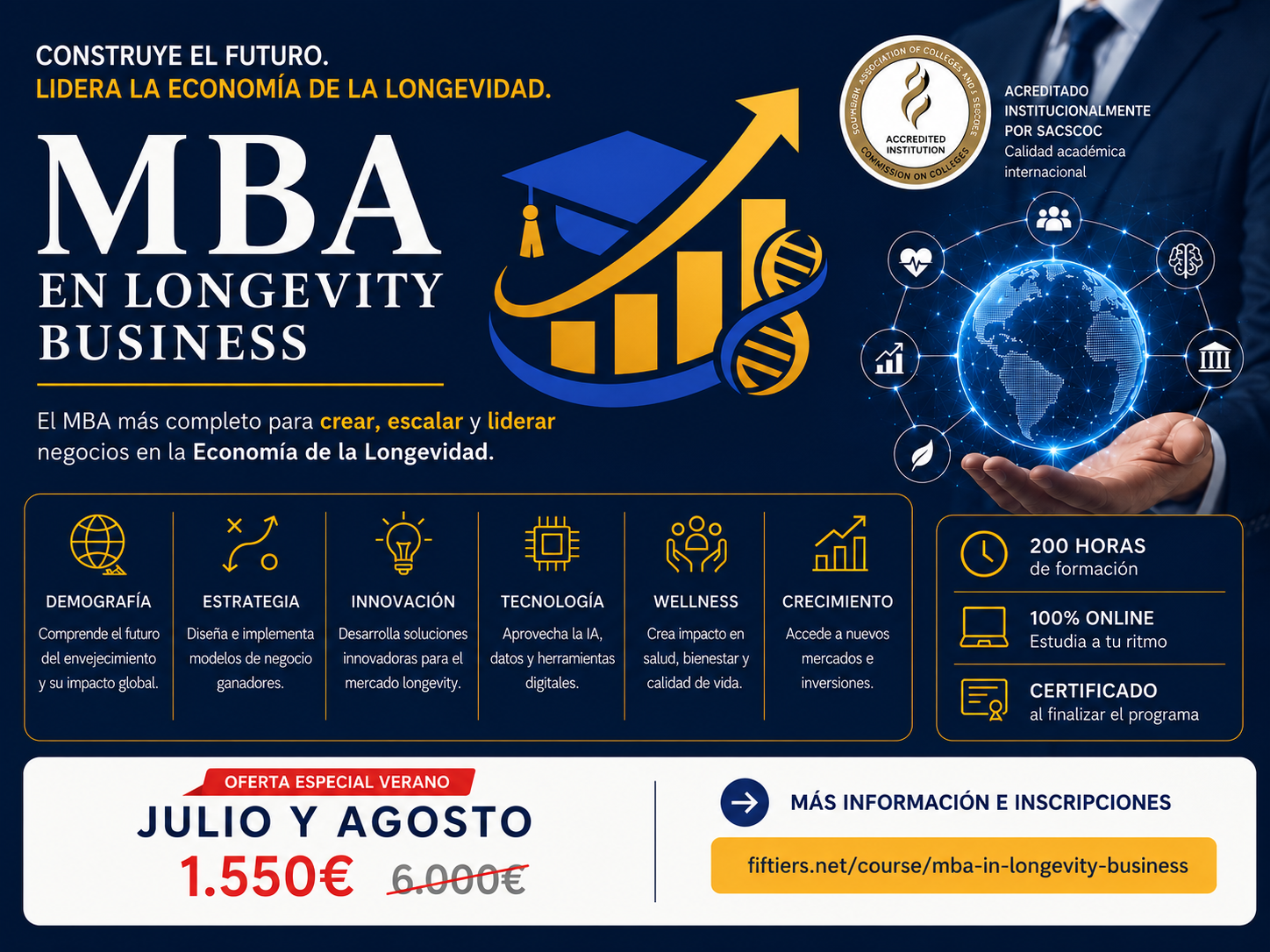


The Immortality Business: The Longevity Industry Heads Toward $1.8 Trillion and Ignites a New Economic, Scientific, and Ethical Race



According to a recent estimate, the anti-aging and longevity industry could reach $1.8 trillion by 2034, a figure that, regardless of how the market is precisely defined, clearly shows that longevity has moved from the margins to the center of the 21st-century economic narrative.
At this point, it is important to clarify what is meant by the “longevity industry.” This is not a single, homogeneous market. Under this label coexist anti-senescence therapies, cellular reprogramming biotech, regenerative medicine, advanced diagnostics, supplements, wearables, biometric platforms, biohacking, personalized health, and premium services aimed at extending both lifespan and healthspan. This is why some estimates place specific segments in the tens of billions, while others, by aggregating multiple layers of business, expand the scope into the hundreds of billions or even beyond a trillion. The $1.8 trillion figure should therefore be understood as a broad ecosystem, not the current size of a single pharmaceutical segment.
What is no longer in doubt is the direction of movement. Longevity is shifting from the periphery to the core. Market data consistently shows sustained growth across nearly all segments connected to this ecosystem. The global biohacking market alone has been estimated at over $24 billion in 2024, with projections reaching nearly $70 billion by 2030, while other forecasts point to strong expansion across longevity-related services and technologies. The key takeaway is not the exact number, but the convergence of projections: accelerated growth, diversification, and rapid institutionalization of the sector.
The real engine behind this expansion is twofold. On one hand, societies are ageing, increasing the pressure to convert longer lifespans into longer periods of functional, healthy living. On the other hand, the science of ageing is no longer seen purely as an academic discipline; it is increasingly attracting capital with the logic of platforms, intellectual property, and scalable innovation. Longevity is no longer marketed solely as a medical promise—it is positioned as a combination of prevention, optimization, extension of healthy life, and, in its most ambitious form, the biological slowing of ageing.
One of the clearest symbols of this new momentum is the entry of major fortunes into the sector. The most widely cited case remains Altos Labs, a company focused on cellular reprogramming that launched with approximately $3 billion in funding and has been linked to Jeff Bezos as one of its key financial backers. The scale of this capital is critical. This is no longer about small startups struggling through early-stage funding rounds. These are projects built with enough financial power to attract top-tier scientists, sustain complex research, and attempt to turn the biology of ageing into an industrial category in its own right.
This flow of capital is not limited to a single flagship company. The broader longevity investment landscape has accelerated sharply. In 2024, global investment in longevity-focused companies reportedly more than doubled to $8.49 billion, reflecting growing confidence from venture capital, family offices, tech billionaires, and specialized funds. Longevity is no longer perceived as a fringe idea; it is increasingly viewed as a convergence of deep science, aspirational narrative, and high-return potential.
At the frontier of this movement are cellular rejuvenation startups. For years, the idea of reversing biological ageing sounded like science fiction. Today, fields such as partial reprogramming, senolytics, regenerative medicine, metabolic modulation, and gene therapy platforms are pushing the conversation toward real-world therapeutic development. This does not mean that ageing has been “cured” in humans. It means that an increasing number of companies and research teams are attempting to transform the biological mechanisms of ageing into products, clinical trials, platforms, and patents.
Surrounding this deep science layer is a second, rapidly expanding universe: extreme biohacking and personal biological optimization. This includes wearables, continuous biomarker tracking, supplements, sleep protocols, sensors, coaching platforms, consumer genetics, and personal health dashboards. This segment plays a crucial role because it acts as the mass entry point into the longevity economy. While therapeutic biotech progresses more slowly due to regulation, cost, and clinical timelines, biohacking translates longevity into recurring consumption and lifestyle identity.
This shift—from hospital to lifestyle—is precisely what makes longevity such a powerful industry. It is not only about drugs or therapies. It is a hybrid market capable of capturing value across multiple layers simultaneously: early diagnostics, digital monitoring, personalized nutrition, female longevity, preventive medicine, insurance, data platforms, corporate wellness, adaptive real estate, functional training, cognitive health, and premium services for high-income individuals. Longevity merges healthcare, consumer markets, technology, AI, fintech, and luxury into a single expanding ecosystem.
However, this economic enthusiasm coexists with a deeply uncomfortable tension: the risk of inequality. By 2050, around 80% of older people will live in low- and middle-income countries, and current data shows that increases in life expectancy do not always translate into increases in healthy life expectancy. In many advanced economies, several years of additional life are lived with illness or reduced functionality. This raises a critical question: will the highest-quality years of extended life be accessible to all, or only to those who can afford the most advanced interventions?
This leads directly to the second major tension: the ethical debate between “living longer” and “living better.” Extending lifespan without extending healthspan creates structural pressure on healthcare systems, families, and economies. The longevity industry therefore faces a fundamental challenge: whether it will prioritize broad, meaningful improvements in quality of life, or fuel a high-end race for biological optimization driven by wealth and technological access.
Two narratives are now competing within the sector. The first positions longevity as a rational response to ageing societies: reducing disease, increasing autonomy, extending productivity, and easing pressure on healthcare systems. The second frames it as an elite-driven pursuit to delay or escape biological ageing itself. Both narratives attract capital. Both are expanding. But their long-term implications for society are radically different.
From a strategic perspective, the key insight is clear: longevity is no longer just a healthcare issue—it is becoming economic infrastructure. It affects capital allocation, pharmaceutical innovation, labor markets, family financial planning, urban design, insurance systems, and even the definition of wellbeing itself. With Asia-Pacific projected to reach 1.3 billion people aged 60 and over by 2050, the scale of the opportunity is enormous.
For companies, the message is immediate. Those that continue to treat longevity as a niche or a passing trend will fall behind. The sector is already generating demand across science, consumer behavior, data, services, and customer experience. There will be winners not only in therapies, but also in diagnostics, biomonitoring, personalized nutrition, cognitive health, corporate wellness, adaptive insurance, and financial products designed for longer life trajectories.
The strategic conclusion is undeniable. Longevity is no longer just about health—it is becoming one of the most disruptive industries of the 21st century. It attracts billions in investment, mobilizes scientists and billionaires, accelerates markets such as biohacking and regenerative medicine, and at the same time opens a profound debate about access, equity, and purpose. It may become a tool to extend healthy life for many—or a biological privilege for a few. But in any case, it is no longer a futuristic curiosity.
Discover more from FIFTIERS
Subscribe to get the latest posts sent to your email.
What's Your Reaction?