



The Silent Revolution of the 50+: The New Archetypes of Active Longevity Redefining the Global Economy


At a time when more than 1.4 billion people worldwide are over the age of 50 —a figure expected to surpass 2.1 billion by 2050 according to estimates from international organizations such as United Nations— a profound transformation is taking place that goes far beyond population aging. What is emerging is a structural shift in the way people live, consume, work, and envision the future.
For decades, the market treated senior consumers as a homogeneous segment, associated with retirement, savings, and stability. That view has been completely surpassed. Today, those over 50 are leading a silent revolution based on active longevity: an extended, diverse life stage full of economic possibilities.
In this new scenario, experts in consumer behavior and the longevity economy agree that the key is no longer age, but rather life archetypes. In other words, how individuals choose to live their additional decades.
From Aging to Life Redesign
The traditional concept of retirement is being replaced by a far more dynamic model. In economies such as the United States and Japan, nearly 30% of people aged 65 to 74 remain professionally active, according to data from the OECD. In Europe, the trend follows the same path, driven both by economic necessity and personal motivation.
But the real shift is not professional, but psychological. Today’s +50 consumer does not perceive themselves as “old.” In fact, market studies show that subjective age is typically between 10 and 15 years younger than chronological age.
This gap between chronological age and perceived age is generating new forms of identity, which translate into entirely different consumption patterns.
The New Profiles Reshaping the Market
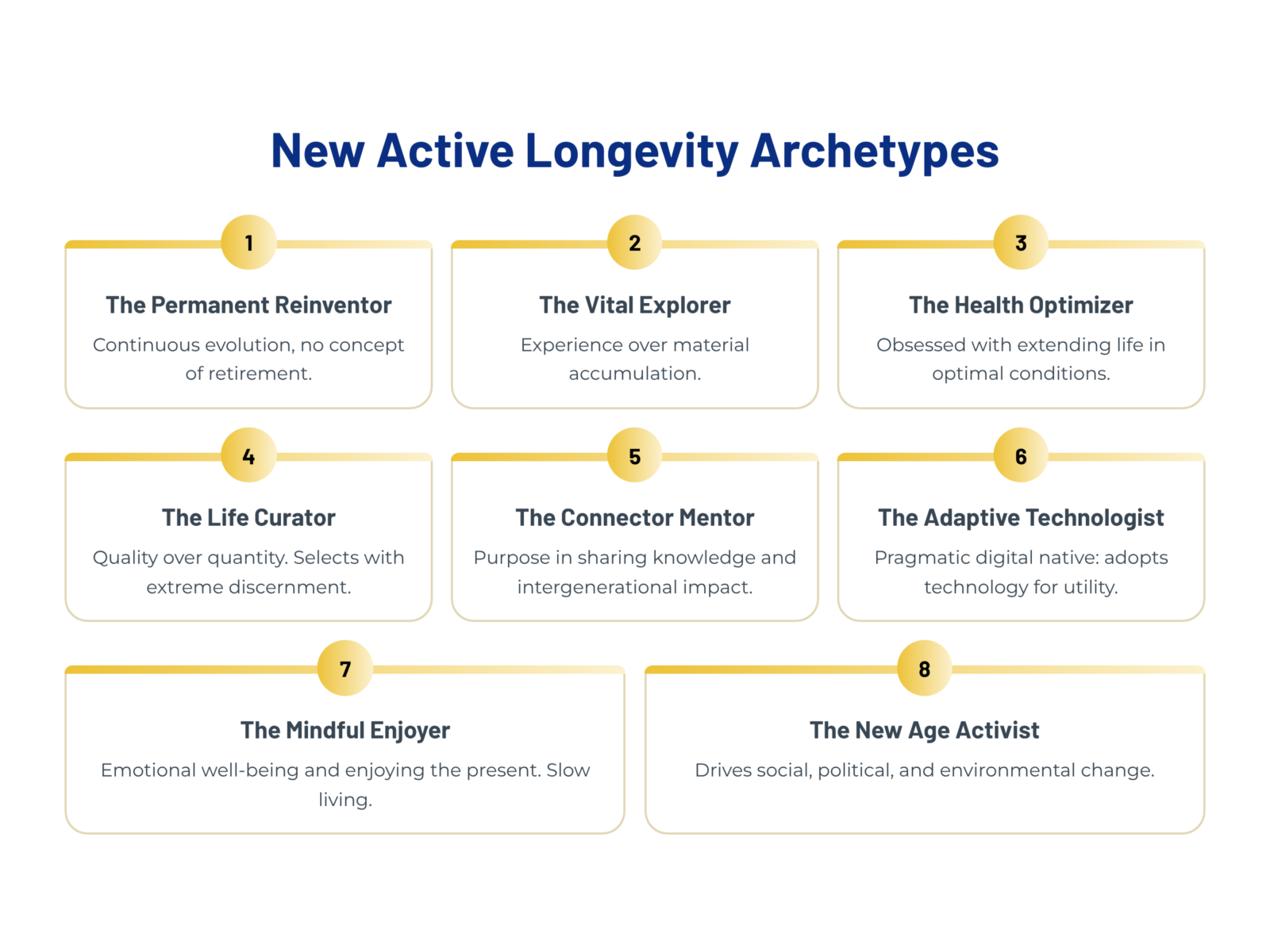
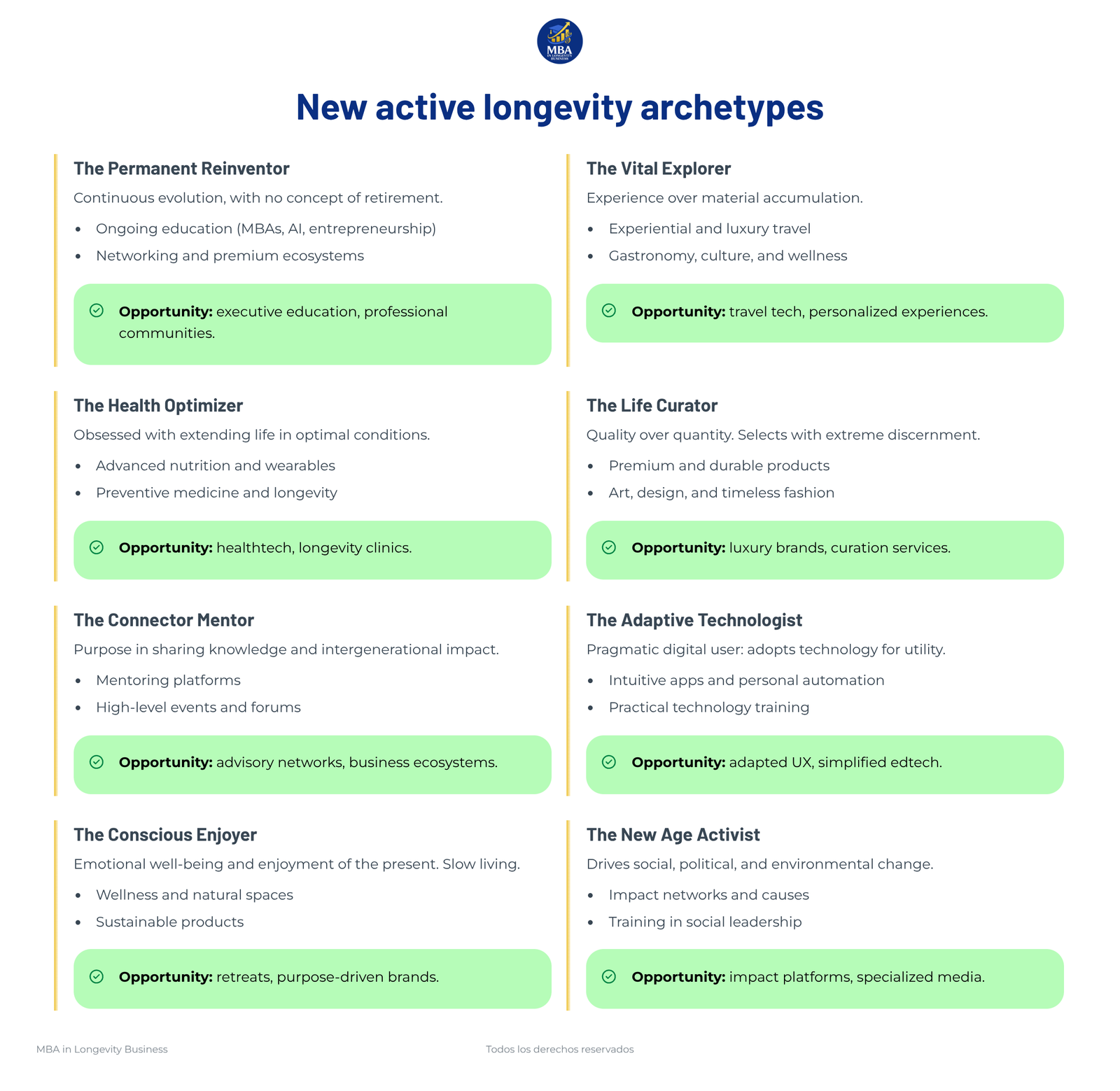
In this context, several archetypes are emerging strongly, already redefining entire industries:
The first is the permanent reinventionist, a profile that rejects retirement and continuously reinvents itself. This group is driving the growth of executive education, senior entrepreneurship, and technology training. Learning platforms and business schools are seeing how the +50 segment is becoming one of their main growth engines.
At the same time, the life explorer stands out, prioritizing experiences over material goods. This archetype is behind the rise of premium tourism, personalized travel, and so-called “luxury experiential travel,” where value lies in the experience, not the object.
Another high-impact profile is the health optimizer, a key driver of the exponential growth of the wellness industry. From preventive medicine to biohacking, including wearable devices and personalized programs, this consumer consistently invests in extending life under optimal conditions.
The life curator is also gaining prominence, evolving from decades of mass consumption toward much more selective choices. Fewer products, but with higher quality, durability, and emotional value. This profile is redefining contemporary luxury.
Technology, Purpose and Community: The Three Pillars of the New 50+
Far from the traditional narrative of digital disconnection, senior consumers are increasingly integrating into the technological ecosystem. The adaptive technologist archetype shows that digital adoption does not depend on age, but on perceived usefulness.
Financial apps, communication platforms, artificial intelligence tools, and digital health solutions are being rapidly adopted, provided they offer a simple experience and clear value.
At the same time, the connector mentor emerges, a profile that seeks to transfer knowledge and generate impact through other generations. This archetype is driving the growth of professional communities, advisory networks, and mentoring platforms.
Finally, the conscious enjoyer and the new-age activist reflect a shift toward emotional well-being, sustainability, and social engagement. Consumption is no longer purely functional but becomes an extension of values and purpose.
A Trillion-Dollar Market in Transformation
The economic impact of these changes is enormous. According to estimates from the World Economic Forum, the so-called “longevity economy” already exceeds $15 trillion annually worldwide, with sustained growth expected in the coming decades.
In developed markets, people over 50 account for more than 60% of private spending and more than 70% of financial wealth. However, many companies still fail to adapt their value proposition to this reality.
The problem is not a lack of market, but a lack of understanding.
The Big Mistake Brands Make
For years, marketing aimed at older audiences has been dominated by stereotypes: messages associated with dependency, illness, or retirement. This narrative is not only outdated but also generates rejection.
The new +50 consumer does not want to be treated as “old,” but as someone in a new stage of expansion.
Brands that understand this transition will not only capture market share but will also position themselves within one of the most solid and profitable segments of the global economy.
The Future: Living 30 More Years… and Better
Longevity is not merely an extension of lifespan, but an expansion of opportunities. What was once considered the end is now a second —or even third— stage with its own identity.
In this scenario, active longevity archetypes are not a passing trend, but the foundation upon which future consumption is being built. The message is clear: the world is not aging, it is evolving toward a new way of living. And in that evolution, those over 50 are not the end of the economic cycle. They are increasingly its true engine.
Discover more from FIFTIERS
Subscribe to get the latest posts sent to your email.
What's Your Reaction?