



The Great Marketing Lie: There Is No Such Thing as “People Over 50”



FIFTIERS | Life Begins at 50. La vida comienza a…
For years, companies have repeated a mistake that is as convenient as it is costly: treating people over 50 as a homogeneous block, a simple category, an easy label for marketing departments. Yet this simplification is not only inaccurate—it is creating a growing disconnect between brands and one of the most powerful consumer groups in the world. The +50 consumer is not a segment. It is a universe—complex, diverse, and evolving. And those who fail to understand this will be left behind in what is becoming the most influential economic force of the coming decades.
We are living through a moment in which longevity has moved beyond being a demographic trend to becoming a structural economic transformation. More than 1.4 billion people worldwide are already over the age of 50, and that number will continue to rise steadily. But what truly matters is not just the scale—it is their position within the economic system. In developed markets, they control the majority of private wealth, lead consumption across multiple industries, and make decisions that affect not only their own lives but also those of their children and, increasingly, their parents. They influence, they decide, and they act.
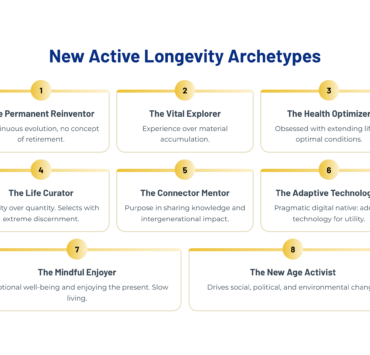
Despite this reality, many companies continue to segment the market as if nothing has changed. They still ask how old someone is, instead of understanding how they live, what motivates them, what they are capable of, and what decisions they are willing to make. That difference, subtle on the surface, represents a fundamental shift between outdated marketing and what comes next. Because two people aged 60 may look identical in a spreadsheet, but they can be radically different in how they live, consume, and project their future. One may be launching a new business, traveling the world, exploring emerging technologies, and making decisions with an expansive mindset. Another may be restructuring finances, prioritizing stability, planning retirement, and focusing on security. Same age. Completely different realities.
This is where a new paradigm emerges: segmentation based on behavior and wealth. It is not an incremental improvement—it is a complete reframing. Behavioral segmentation allows companies to understand how consumers act in real life: how they make decisions, what they value, how they use their time, how they relate to technology, what builds trust, and what breaks it. In the +50 space, this dimension becomes particularly powerful. These are individuals with accumulated experience, strong judgment, lower tolerance for friction, and a refined ability to detect inconsistencies in brand promises. They do not buy on impulse—they buy with intention. They are not looking for the cheapest option—they are looking for meaning. They do not want isolated products—they want solutions that fit their stage of life.
But understanding behavior is only half the equation. The other half—arguably the most decisive—is wealth. The +50 population does not just participate in the economy; it controls it. In many developed countries, this group holds more than 60% of private wealth, with assets ranging from real estate and investment portfolios to businesses and complex financial structures. They have liquidity—or the ability to generate it—and in many cases, they are making decisions that impact multiple generations. This introduces a critical variable: the real capacity to act. Because wanting and being able are not the same thing.
When behavior and wealth intersect, the market becomes far more nuanced—and far more interesting. It is not the same to engage an active consumer with high wealth as it is to engage someone equally dynamic but with limited resources. It is not the same to serve someone focused on preserving wealth as someone determined to enjoy it. It is not the same to communicate with an individual planning a legacy as with someone reinventing their professional life. Yet many brands still speak to all of them in the same way. That gap between reality and strategy is one of the most critical failures in modern marketing.
The companies that understand this shift will not compete on the same terms as everyone else. They will not rely on mass campaigns or generic products. Instead, they will design precise value propositions tailored to real lifestyles. They will develop modular offerings, flexible pricing models, and hybrid experiences that combine digital efficiency with human interaction. Most importantly, they will transform their communication. They will move away from condescending narratives or outdated stereotypes and embrace messaging built around continuity, evolution, and possibility.
Because the +50 consumer does not want to be spoken to as “older.” They want to be addressed as someone who has lived, learned, and continues to evolve.
And this is where many brands fail dramatically. They still rely on unrealistic imagery, oversimplified messaging, or narratives centered on decline, when what this audience truly seeks is recognition, relevance, and alignment with their reality. They do not want to feel excluded from the market. They want to feel central to it. And increasingly, they are.
The longevity economy is not a passing trend. It is a reconfiguration of the global marketplace. Within it, behavioral and wealth-based segmentation are no longer optional—they are essential. At the same time, technology—especially artificial intelligence—is accelerating this transformation. Today, companies can analyze behavior in real time, anticipate needs, personalize offerings at scale, and build predictive models that reveal patterns once invisible. But technology alone is not the answer.
The real shift is not in the data—it is in the mindset.
Companies that continue to see the +50 consumer as a single category will continue to lose relevance. Those that embrace its complexity, diversity, and economic power will build competitive advantages that are difficult to replicate. The question is no longer whether segmentation needs to evolve. The question is how long a company can afford to delay that evolution.
Because while some are still talking about age… others are already designing the future.
Discover more from FIFTIERS
Subscribe to get the latest posts sent to your email.
What's Your Reaction?