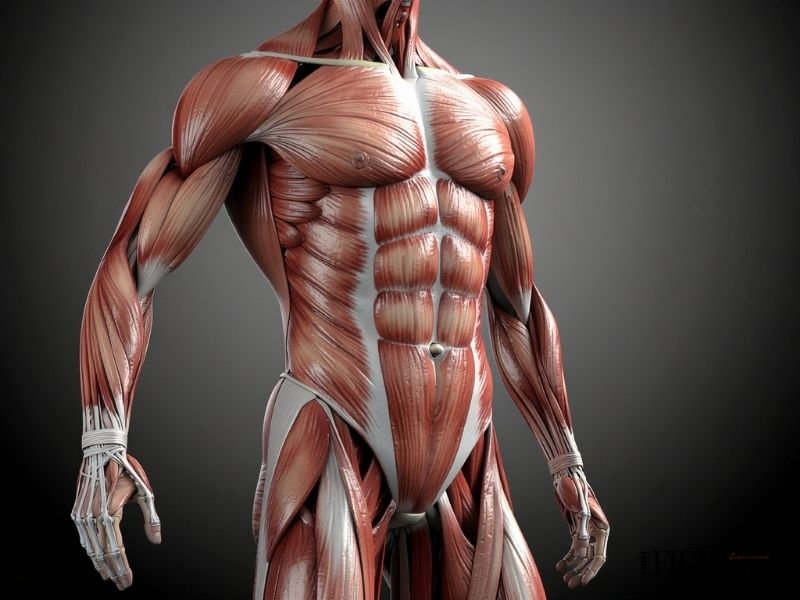
For decades, the gradual loss of muscle strength has been accepted as an almost unavoidable consequence of aging. After 50, the body begins to lose muscle mass and power quietly but steadily, affecting not only mobility but also autonomy, metabolic health, and overall quality of life. A recent line of research, however, is reshaping this narrative. At the center of this shift is a protein little known outside scientific circles, yet with remarkable potential: tenascin-C.
The latest studies in cellular biology and tissue regeneration suggest that this protein plays a decisive role in the muscle’s ability to repair itself and remain functional with age. This is not a supplement or a commercial therapy, but a deep biological mechanism that helps explain why some bodies age with greater physical resilience than others—and how muscle strength might be preserved well into later stages of life.
Tenascin-C is part of the extracellular matrix, the microscopic network that surrounds cells and that for many years was considered little more than structural support. Today, it is understood that this matrix acts as a complex allowing cells to communicate. In muscle tissue, its role is especially critical because it directly influences muscle stem cells, which are responsible for repairing and regenerating tissue after exertion or injury.
As the years pass, these stem cells do not disappear, but they become less efficient. They respond more slowly and are less capable of reacting to environmental signals. Research has shown that one of the factors driving this decline is the gradual deterioration of the cellular environment itself. Tenascin-C appears as a mediator in this process: when it is present and active, the muscular microenvironment becomes more supportive, enabling stem cells to activate, multiply, and repair muscle tissue more effectively.
The most recent experiments, conducted in animal models and human cell cultures, show that adequate levels of tenascin-C are associated with improved muscle regeneration even in aged tissue. In practical terms, this translates into faster recovery after exercise, better preservation of muscle mass, and a stronger response to physical training later in life.
This discovery holds particular relevance for the FIFTIERS generation, which no longer views aging as a gradual withdrawal, but as a phase of continued activity. Muscle strength is not merely a matter of appearance or athletic performance. It is directly linked to fall prevention, bone health, glucose control, cardiovascular function, and functional independence. Preserving muscle is, in many ways, preserving freedom.
One of the most compelling aspects of this research is that it does not propose extreme or futuristic solutions. Instead, it helps clarify why well-established strategies already work. Strength training, for example, does more than mechanically stimulate muscle; it alters the cellular environment, promoting the expression of proteins such as tenascin-C. Training, in this sense, does not only build visible muscle—it renews its internal ecosystem.
This opens a clear vision of what lies ahead. Active longevity will not rely solely on drugs or external interventions, but on combining biological insight with habits sustained over time. Adapted training, adequate rest, proper nutrition, and an understanding of cellular processes all form part of the same system. Science is not promising eternal bodies, but bodies that remain capable of responding to the passage of time.
It is also revealing that this protein is linked to adaptation rather than excess. Tenascin-C is activated when tissue needs it—when there is stimulus, when there is challenge. This aligns with a central idea in healthy aging: the body improves when it is challenged intelligently. Prolonged inactivity accelerates decline; controlled stimulus preserves responsiveness.
For FIFTIERS, this type of advance reinforces a growing conviction: getting older does not mean surrendering to fragility. It means understanding the body more deeply and acting accordingly. Research on tenascin-C does not invite easy promises, but it does encourage a profound rethinking of physical aging. Strength does not vanish overnight; it fades when the environment no longer supports it.
In a world where life expectancy continues to extend and life stages are being redefined, maintaining muscle is about maintaining a life project. The ability to travel, work, create, move, and decide without dependence is a direct form of well-being. Science is beginning to show that this outcome is not a genetic exception reserved for a few, but the result of understanding and supporting the body’s natural mechanisms.
Ultimately, the story of tenascin-C is a story of cooperation between biology and lifestyle. It is further evidence that the future of aging does not lie in denying age, but in inhabiting it with knowledge, strategy, and strength sustained over time.