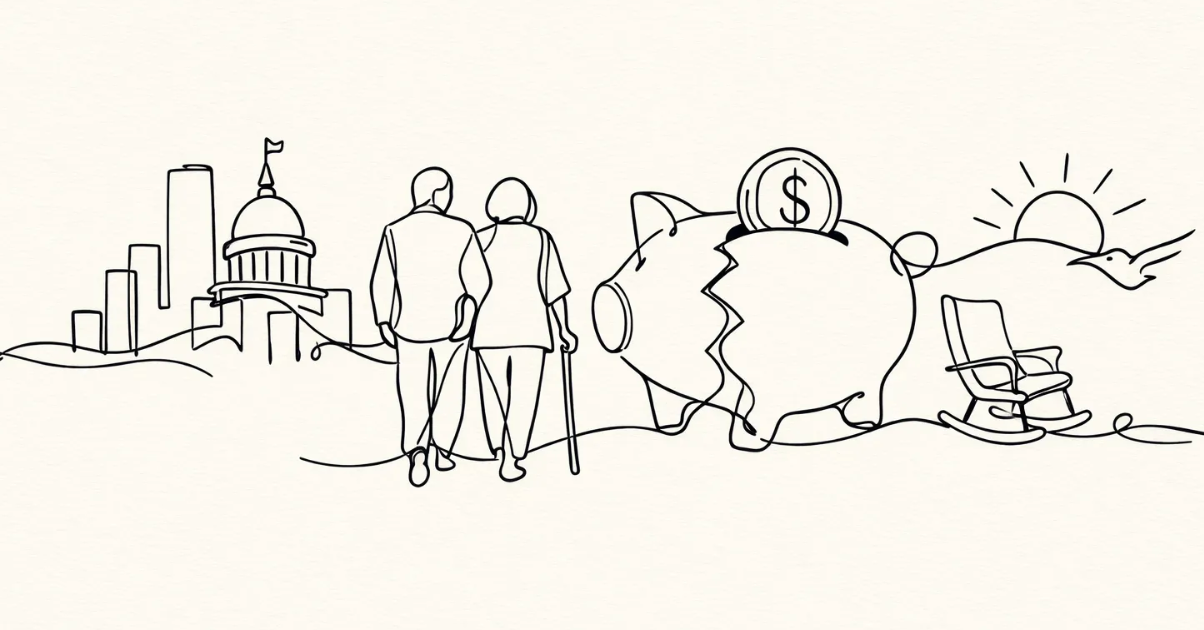
Public pension systems in the United States are once again at the center of economic and social debate. A recent report by the Reason Foundation warns that, despite a modest short-term improvement, the gap between promised benefits and actual funding remains deep and persistent. For millions of citizens over the age of 50—many already retired and others approaching retirement—this reality raises pressing questions about stability, security, and quality of life in the years ahead.
According to the analysis, state and local pension plans still carry close to $1.5 trillion in unfunded liabilities. In practical terms, this means that for every dollar committed to future benefits, the system holds only about 78 cents in assets. While this ratio has improved slightly compared with previous years, largely due to favorable market returns, experts agree that such progress is fragile and heavily dependent on economic cycles.
A structural issue, not a temporary one
The roots of the problem go far beyond market volatility. For decades, many states and municipalities promised generous benefits without making the necessary contributions to support them. This has been compounded by overly optimistic return assumptions, rapid population aging, and increasing life expectancy.
The outcome is growing pressure on public budgets. An ever-larger share of revenue is being diverted to cover past obligations, leaving less room for current investment in healthcare, education, or infrastructure. For active taxpayers—especially those over 50 who are still working—this creates a dual burden: financing the system today while questioning its reliability tomorrow.
States under particular strain
The situation varies widely across the country. States such as Illinois, California, New Jersey, and Connecticut face some of the highest per-capita pension debts and the weakest funding ratios. In these regions, pension obligations directly shape fiscal and budgetary decisions, influencing everything from tax increases to spending cuts.
For residents, many of whom are already in the later stages of their working lives, the concern is immediate: will promised benefits be preserved, will future adjustments be required, and who will ultimately bear the cost of the imbalance?
Direct impact on people over 50
For the generation now aged 50 to 70, pensions are not an abstract financial concept. They are the foundation of economic independence, access to care, and the ability to plan an active and dignified retirement. Any strain on the system affects life decisions: delaying retirement, re-entering the labor market, or relying more heavily on private savings.
In an environment of persistent inflation and rising healthcare costs, certainty around future income becomes a decisive factor for both financial and emotional well-being.
Reform debates and a forward-looking view
Against this backdrop, discussions around pension reform are intensifying. Proposals include shifting new employees toward hybrid or defined-contribution models, sharing costs more evenly between employers and workers, and adopting more conservative investment strategies.
Yet meaningful change requires political and social consensus, a challenge in a country marked by deep divisions and diverse regional realities. What is increasingly evident is that postponing action only heightens long-term risk.
A generational challenge
Beyond balance sheets and funding ratios, the pension debate is fundamentally a generational issue. It affects those who have contributed for decades as well as those still doing so with the expectation of fair returns. For the FIFTIERS community, this discussion is closely tied to the right to an active, independent, and well-planned later stage of life.
The future of public pensions will not be determined by financial markets alone, but by the ability of governments to anticipate change, act responsibly, and design systems that respond to a society that lives longer, works differently, and demands clarity at a pivotal moment of life.